
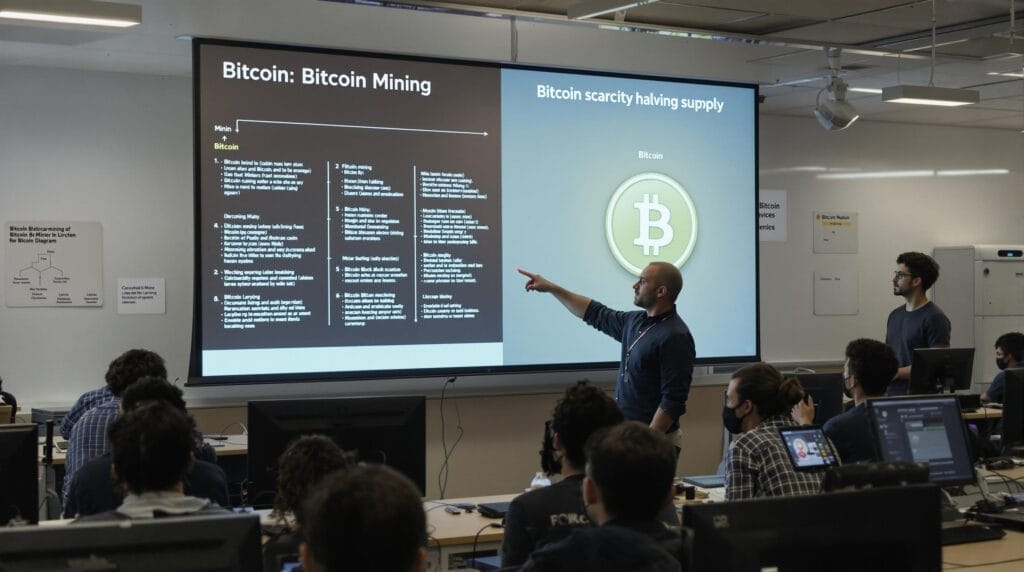
Bitcoin. It’s a name that sparks conversations, debates, and often, a fair bit of confusion. You hear about its price swings, its mysterious origins, and its promise of a new financial era. But have you ever stopped to think about its very foundation? What makes Bitcoin, well, Bitcoin? A big part of that story lies in its scarcity, a concept baked right into its code from day one.
- Bitcoin’s scarcity is built into its code with a fixed supply of 21 million coins, influencing its value and network security.
- A significant portion of mined Bitcoin is lost forever due to forgotten passwords and lost wallets, further reducing the available supply.
- Bitcoin’s mining incentives are designed to adapt to changing conditions, ensuring network security even as block rewards decrease over time.


Imagine a digital gold mine, but one with a very clear, unchangeable limit. That’s Bitcoin for you. Most of it is already out there, dug up and circulating. This isn’t just a fun fact; it shapes everything about Bitcoin’s future, from its value to how its network stays secure. Let’s pull back the curtain and see what this means for everyone involved.
The Digital Gold Rush: How Much Bitcoin is Left to Mine?
Bitcoin’s total supply is set in stone: 21 million coins. Not one more. This isn’t a suggestion; it’s a rule written into the very heart of its protocol. Think of it as a hard cap, a fixed upper limit that simply cannot be changed without a massive, network-wide agreement, which is highly unlikely. This fixed supply is a core reason why many see Bitcoin as a deflationary asset, much like a rare commodity.
As of May 2025, about 19.6 million Bitcoin have already been brought into existence. That’s roughly 93.3% of the total supply. This leaves around 1.4 million Bitcoin still waiting to be discovered. But here’s the kicker: those remaining coins will be mined at a snail’s pace, far slower than the early days.
Why the slow down? It all comes down to something called the “halving.” When Bitcoin first launched in 2009, miners received a hefty 50 Bitcoin for each block they successfully added to the blockchain. But every 210,000 blocks, which works out to roughly every four years, that reward gets cut in half. It’s a built-in mechanism designed to control supply.
Because the initial rewards were so generous, over 87% of all Bitcoin was mined by the end of 2020. Each halving event drastically slows down the creation of new coins. This means it will take over a century to mine the remaining 6.7%. It’s a bit like trying to empty a bathtub when the faucet keeps getting smaller and smaller.
Current estimates suggest that 99% of all Bitcoin will be mined by 2035. But the very last bits – those tiny fractions known as satoshis – won’t see the light of day until around the year 2140. This is due to the way the reward reduction works, a geometric pattern that keeps shrinking the amount over time. It’s a long game, for sure.
This carefully engineered scarcity, paired with an unchangeable supply limit, is why Bitcoin often gets compared to physical gold. But Bitcoin has an edge. Gold’s supply still grows, albeit slowly, at about 1.7% annually. Bitcoin’s issuance rate, on the other hand, is transparently and predictably declining. You know exactly what you’re getting with Bitcoin’s supply schedule.
Did you know? Bitcoin’s supply curve isn’t like a finish line you cross. It follows what’s called an asymptotic trajectory. Think of it as an economic version of Zeno’s paradox, where rewards get smaller and smaller but never quite hit zero. Mining will keep going until about 2140, by which point more than 99.999% of the 21 million Bitcoin will be out there.
The Vanishing Act: Bitcoin’s Hidden Scarcity Beyond the Cap
So, we know over 93% of Bitcoin has been mined. But here’s a twist: that doesn’t mean it’s all ready for use. A big chunk of Bitcoin is actually gone for good, lost forever. How does this happen? Forgotten passwords, misplaced digital wallets, hard drives that crashed and took everything with them, or early adopters who simply never bothered to touch their coins again. It’s a digital treasure hunt with some very permanent dead ends.
Firms like Chainalysis and Glassnode, who track these things, suggest that somewhere between 3.0 million and 3.8 million Bitcoin are likely out of circulation permanently. That’s a huge chunk, roughly 14% to 18% of the total supply. This includes some very famous, very old addresses, like the one believed to belong to Satoshi Nakamoto, Bitcoin’s mysterious creator. That address alone holds over 1.1 million Bitcoin, untouched for years.
This means Bitcoin’s actual circulating supply might be closer to 16 million or 17 million, not the full 21 million. And because Bitcoin is designed to be non-recoverable, any coins lost stay lost. This quietly reduces the available supply over time. It’s a slow, steady drain, making the remaining coins even more valuable.
Now, let’s compare that to gold. About 85% of the world’s gold has been mined, around 216,265 metric tons. But nearly all of it is still around, held in vaults, used in jewelry, or stored by central banks. Gold can be melted down and reused. Bitcoin, once access is lost, cannot be brought back. It’s a stark difference.
This distinction gives Bitcoin a unique kind of “hardening scarcity.” Its supply doesn’t just stop growing; it actually shrinks over time. It’s a fascinating concept, making Bitcoin even more rare than its fixed cap suggests. It’s like a rare painting that slowly fades away, making the remaining copies even more precious.
As Bitcoin grows up, it’s moving into a monetary phase similar to gold. We see low new issuance, a lot of coins held by a few long-term holders, and demand having a bigger impact on price. But Bitcoin takes it further. Its supply cap is truly fixed, lost coins are gone forever, and its distribution is open for anyone to see. It’s all out in the open.
What might this lead to? We could see more price swings as the available supply becomes tighter and more sensitive to what the market wants. It also means that long-term value might concentrate more with those who are careful with their digital keys and keep their coins secure. And there might be a premium on “spendable” Bitcoin, where coins that are actually moving trade at a higher effective value than those sitting dormant.
In some extreme situations, this could even create a divide between “circulating Bitcoin” and “unreachable Bitcoin.” The circulating coins would gain more economic importance, especially when there’s not much Bitcoin available on exchanges or during tough economic times. It’s a subtle but powerful force at play.
The Long Game: What Happens When Bitcoin is Fully Mined?
There’s a common worry that as Bitcoin’s mining rewards get smaller, the network’s security will suffer. It’s a fair question. After all, miners are the ones keeping the network safe. But in reality, the mining economy is much more flexible and tougher than people often think. It’s built to adapt, not to crumble.
Bitcoin’s mining incentives work like a self-correcting system. If mining becomes too expensive or not profitable enough, some miners simply stop. When miners drop off, the network automatically adjusts its difficulty. Every 2,016 blocks, which is about every two weeks, the network recalibrates how hard it is to mine a new block. The goal? To keep block times steady at around 10 minutes, no matter how many miners are competing.
So, if Bitcoin’s price dips, or the reward becomes too small compared to the costs of running mining equipment, the less efficient miners just step away. This causes the difficulty to fall, which then lowers the cost for the miners who remain. The result is a system that constantly finds its balance, making sure that participating in the network always makes sense financially. It’s a clever design.
This mechanism has already been put to the test on a grand scale. When China banned Bitcoin mining in mid-2021, the global hashrate – a measure of the network’s computing power – dropped by more than 50% in just a few weeks. Yet, the network kept running without a hitch. Within a few months, the hashrate fully recovered as miners moved their operations to places with cheaper energy and more favorable rules. It showed just how resilient Bitcoin truly is.
Crucially, the idea that lower rewards will automatically threaten network security misses a key point. Mining is tied to profit margins, not just the raw number of Bitcoin received. As long as the market price supports the cost of the computing power needed – even at 0.78125 Bitcoin per block after the 2028 halving, or even lower – miners will continue to secure the network. They are in it for the profit, not the specific number.
In other words, it’s not the absolute reward that matters most. What truly counts is whether mining remains profitable compared to the costs involved. And thanks to Bitcoin’s built-in difficulty adjustment, it usually does. This system ensures that the incentives are always aligned, keeping the network strong and secure.
Even a century from now, when the block reward is almost nothing, the network will likely still be protected. This will happen through a mix of transaction fees, basic incentives, and efficient infrastructure that exists at that time. But that’s a concern for the distant future. For now, the current system – where hashrate adjusts, difficulty rebalances, and miners adapt – remains one of the strongest parts of Bitcoin’s design.
Did you know? On April 20, 2024, after the launch of the Runes protocol, Bitcoin miners earned over $80 million in transaction fees in a single day. This was more than the $26 million they earned from block rewards. It was the first time in Bitcoin’s history that transaction fees alone brought in more daily revenue for miners than the block subsidy.
Powering the Future: Bitcoin’s Energy Footprint and Beyond
It’s a common misunderstanding that if Bitcoin’s price goes up, its energy use will just keep climbing forever. This isn’t quite right. In reality, Bitcoin mining is limited by how profitable it is, not just by its price. Miners are always looking for the most cost-effective ways to operate, and that often means finding the cheapest energy available.
As the block rewards shrink, miners are pushed to operate on tighter profit margins. This means they are constantly searching for the cheapest, and often the cleanest, energy sources out there. Since China’s mining ban in 2021, a lot of the mining power has moved to places like North America and Northern Europe. Here, operators can tap into extra hydro power, wind energy, and grid energy that isn’t being fully used. It’s a shift towards more sustainable practices.
According to the Cambridge Centre for Alternative Finance, between 52% and 59% of Bitcoin mining now runs on renewable or low-emission sources. This is a significant move towards greener operations. It shows that the industry is adapting and finding ways to reduce its environmental impact, contrary to some popular narratives.
Regulations are also helping this trend along. Several places are now offering incentives for mining operations that use clean power. Some are even penalizing those that rely on fossil fuels. This pushes miners further towards sustainable energy solutions, making the network’s energy profile cleaner over time. It’s a win-win for both the environment and the mining industry.
Moreover, the idea that higher Bitcoin prices will always mean higher energy use misses how Bitcoin regulates itself. More miners joining the network raises the mining difficulty. This, in turn, squeezes profit margins, which then puts a cap on how much energy expansion can occur. It’s a built-in brake system.
While renewable-based mining certainly has its own set of challenges, the grim picture of endlessly expanding fossil-fueled computing power for Bitcoin is becoming less and less likely. The system is designed to find equilibrium, and that includes its energy consumption. It’s a dynamic process, always seeking balance.