
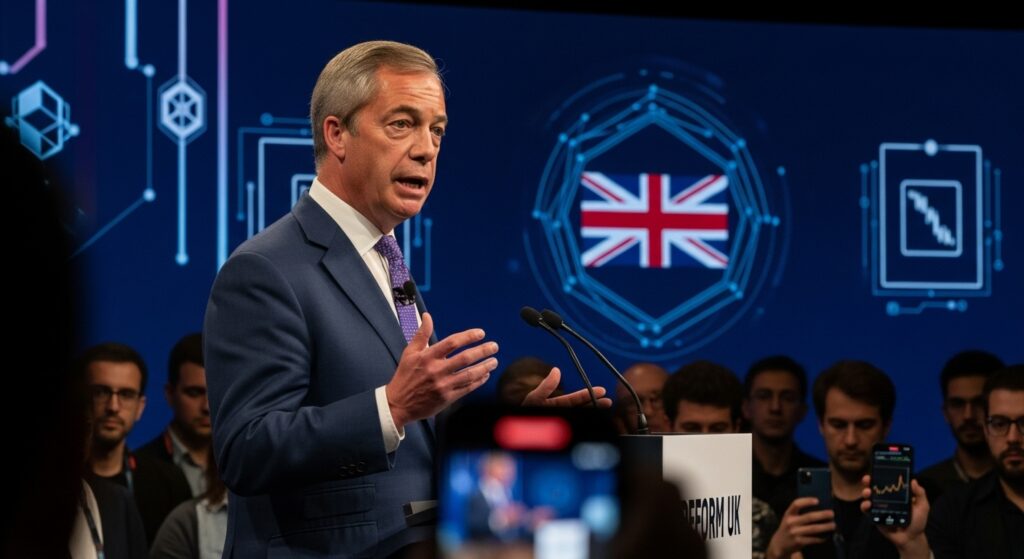
The air at London’s Zebu Live conference crackled with a distinct energy the other day. Nigel Farage, the leader of Reform UK, took the main stage. He wasn’t there to discuss traditional economics alone. Instead, he spoke directly to a growing segment of the electorate, those with a keen eye on digital assets.
- Nigel Farage, leader of Reform UK, expressed strong opposition to Central Bank Digital Currencies (CBDCs), viewing them as a tool for government control and digital identification.
- Reform UK proposes a bold digital vision for the UK, aiming to make it a global hub for crypto by establishing a clear regulatory framework and reducing capital gains tax on crypto assets.
- The party plans to introduce a Crypto Assets and Digital Finance Bill, which would include a “bitcoin digital reserve” within the Bank of England and protect individuals from having their bank accounts closed due to crypto engagement.


Farage, a figure known for his strong opinions, didn’t hold back. He laid out Reform UK’s stance on crypto, a move that could reshape the country’s political landscape. His party, currently seeing a surge in popularity, aims to challenge the long-standing two-party system.
During a fireside chat, Farage made his position on central bank digital currencies, or CBDCs, crystal clear. He called them a “total and utter horror.” This isn’t just a casual dislike. He sees them as a tool fitting into the government’s broader plans for digital identification.
The UK has been quietly exploring a potential CBDC for some time. The Bank of England and HM Treasury have publicly stated they remain undecided on its necessity. But Farage shared a different story. He claimed Andrew Bailey, the central bank’s governor, had privately indicated plans to move forward.
This alleged private revelation fueled Farage’s passionate opposition. He declared, “I would rather go to prison, and I’m prepared to go to prison” to prevent CBDCs from being linked to a digital ID system. That’s quite a statement, isn’t it? It shows a deep conviction, a willingness to stand firm on a principle.
Reform UK’s Digital Vision
Farage, a former commodities trader, reflected on his career in London. He channeled a familiar theme from President Trump’s U.S. presidential campaign. He pledged to make London “a great place again,” specifically by embracing new opportunities like crypto.
He criticized the current government and regulators. He believes they have created an environment that stifles entrepreneurs, businesses, and innovation. His vision is different. “I want to bring in digital assets and crypto from the cold, in London,” Farage said.
He promised a clear regulatory framework. This framework would allow everyone to operate fairly. If he enters Number 10 Downing Street, he aims to make the UK a global hub for crypto. This is a bold promise, one that certainly caught the attention of the Zebu Live audience.
Farage first outlined these plans at the Bitcoin 2025 conference in Las Vegas earlier this year. He intends to introduce a Crypto Assets and Digital Finance Bill. This would happen if Reform UK wins the next general election. That election must occur no later than August 15, 2029.
While a few years away, this proposed legislation carries significant implications. It would establish a “bitcoin digital reserve” within the Bank of England. Imagine that. A national reserve, not of gold, but of Bitcoin.
The bill also includes a reduction in capital gains tax. It would drop from 24% to 10%. This could certainly make crypto trading more attractive. Another key provision aims to protect individuals. It would make it illegal for banks to close customer accounts simply because they engage with crypto exchanges or trade legal cryptocurrencies.
The UK already holds a substantial amount of Bitcoin. It has 61,245 BTC, valued at about $6.5 billion. This places it as the third-largest known holder among sovereign nations. China and the U.S. hold more. These holdings largely come from criminal seizures.
Bitcoin Treasuries, which tracks such data, provides these estimates. However, the government has not been entirely transparent about where these seized assets are held. They cite operational and security risks. This lack of clarity leaves some wondering about the future of these digital assets.
Farage confirmed Reform’s commitment to establishing a formal reserve. But he also voiced a concern at the conference. He worries the current Labour Chancellor of the Exchequer, Rachel Reeves, might sell off these assets. This could be an attempt to address the country’s fiscal challenges.
Farage’s personal journey with crypto is also noteworthy. He discussed his own challenges with debanking in 2020. This experience, he said, transformed his view. He already saw crypto as a valid industry. But the debanking incident made him see it as the “ultimate freedom of the 21st century.”
He spoke of being in control of your own money. He highlighted making your own decisions, free from authoritarian government. It’s a powerful message, one that resonates with many in the crypto community.
The Shifting Political Sands
Traditionally, the center-left Labour government and the center-right Conservative Party have dominated UK elections. Reform UK is a newer player. It emerged from key figures associated with the UK Independence Party, including Farage himself. It started as The Brexit Party in 2018, then rebranded in 2021.
Recent aggregated seat-projection data from Electoral Calculus paints an interesting picture. Reform UK currently stands at 30.4% of voting intention for the next general election. The Labour government trails at 21.3%. The Conservatives are at 17.2%, the Liberal Democrats at 14%, and the Green Party at 9.6%.
These numbers suggest a significant shift. They could translate to 301 members of parliament for Reform. Labour would get 153, Liberal Democrats 71, Conservatives 51, and the Greens 6. If these projections hold, it would mark a historic change in UK politics.
The UK has adopted a phased approach to crypto regulation. The goal is to position itself as a global hub for digital assets. At the same time, it prioritizes consumer protection and financial stability. It’s a careful balancing act.
Before the last UK general election in 2024, most major UK political parties remained silent on crypto. None mentioned it in their manifestos. They also did not respond to requests for comment on crypto-specific policies. Reform UK, however, broke this silence.
In May, Reform became the first UK political party to accept crypto donations from eligible donors. Zia Yusuf, the party chair, even suggested that HMRC (His Majesty’s Revenue and Customs) should allow people to pay their taxes in crypto. That’s a truly forward-thinking idea, isn’t it?
The number of UK adults owning crypto is growing. The latest FCA research estimates around 7 million, or 12% of the population. Other industry surveys place that figure closer to 25%. This means a substantial portion of the electorate has a stake in the digital asset space.
Much like President Trump found in the U.S., crypto could become an increasingly important battleground in UK politics. As more people engage with digital assets, their concerns and interests will demand attention from political parties. The stakes are rising. It seems the conversation around digital currencies and assets is only just beginning to warm up.