
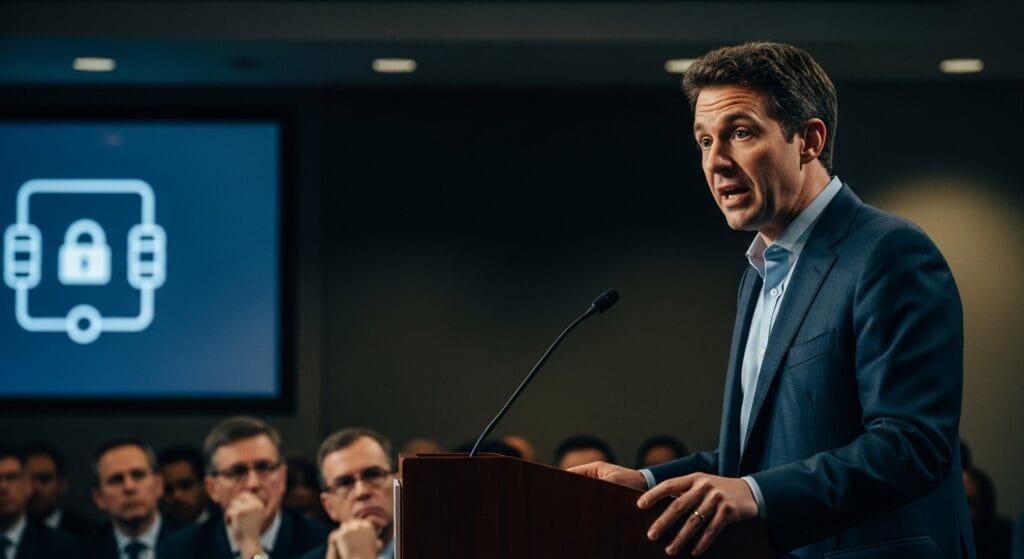
Brad Garlinghouse, the CEO of Ripple Labs, recently stepped up to the microphone at DC Fintech Week. He didn’t mince words. His target was clear: the Wall Street banking lobbyists who, he says, are actively trying to keep crypto firms out of the traditional banking system.
- Ripple CEO Brad Garlinghouse criticizes Wall Street lobbyists for blocking crypto firms’ access to traditional banking infrastructure, specifically Federal Reserve master accounts. He argues that if crypto firms meet high standards for illicit finance, they should receive equal access.
- Garlinghouse labels this resistance as hypocritical and anti-competitive, highlighting the difficulty crypto firms face in obtaining essential financial tools like Fed master accounts, as exemplified by Custodia Bank’s failed lawsuit.
- Ripple is actively pursuing integration through its own master account application, a federal banking charter, and the launch of a stablecoin, indicating a strategic move towards mainstream financial inclusion.


Specifically, Garlinghouse called out the resistance to crypto companies gaining access to the Federal Reserve’s master accounts. It’s a key piece of financial plumbing, and he believes crypto deserves a seat at that table.
He made a point to agree with traditional bankers on one thing. The crypto sector, he noted, should absolutely meet the same high standards for money-laundering protections and other illicit-finance safeguards. No arguments there, he suggested.
But here’s the twist. If crypto firms are held to those same standards, Garlinghouse argued, then they should also get the same access to vital infrastructure. He meant things like a Fed master account. “You can’t say one and then combat the other,” he stated plainly.
He didn’t stop there. Garlinghouse labeled this resistance as “hypocritical.” He urged everyone to call out these actions for being “anti-competitive.” It’s a strong charge, suggesting that established players are trying to block new entrants, not just protect the system.
So, what exactly is a Fed master account? Think of it as a direct line to the central bank. For traditional banks, it means seamless integration into the U.S. financial system. It offers direct access to the Fed’s systems, a benefit that forms the core of how banks operate.
For crypto firms, getting this access has been a tough road. Many have tried. Many have faced significant challenges. Sometimes, the Fed hasn’t even clearly explained how such access could be obtained, leaving firms in a kind of regulatory limbo.
We saw this play out with Custodia Bank, a crypto-focused institution. They lost a lawsuit challenging the Fed’s rejection of their master account application. It shows just how difficult this path can be.
Ripple, for its part, isn’t just talking. The company recently applied for a master account through its affiliate, Standard Custody & Trust Co. This is a New York trust, already operating within a regulated framework.
At the same time, in July, Ripple also sought a federal banking charter from the Office of the Comptroller of the Currency (OCC). These are concrete steps toward deeper integration into the established financial world. It shows a clear strategy.
Ripple has also moved into the stablecoin space. They plan to roll out their RLUSD stablecoin. This move itself signals a desire to connect more closely with traditional finance, where stablecoins can act as a bridge.
Garlinghouse shared an interesting observation. He said banks are finally starting to take crypto firms more seriously. This comes after years of difficulty, where resistance from U.S. regulators made financial firms reluctant to engage with the crypto sector.
He recounted meetings he had just the day before in New York City. “Banks that would not have talked to us three years ago are now leaning in and saying, how could we partner around this?” he explained. Those conversations, he confirmed, centered on Ripple’s stablecoin effort.
It’s a notable shift. For a long time, crypto was seen as an outsider, perhaps even a threat. Now, some established players are seeing potential for collaboration, especially in areas like stablecoins, which offer a digital form of traditional currency.
Garlinghouse believes that granting master accounts to crypto firms like Ripple and Circle would bring several benefits. He listed more stability, better regulatory oversight, and improved risk mitigation. These are all things traditional finance values highly.
So, if crypto firms are willing to play by the rules, and if their inclusion can bring more stability, why the resistance? That’s the core of Garlinghouse’s argument. He finds it “a little disappointing to see some of the traditional banks start to lobby against things like that.”
It raises a question: Is it about genuine risk, or is it about protecting existing market share? Garlinghouse clearly leans toward the latter. He sees a double standard at play, where new players are asked to meet high bars but then denied the tools to do so effectively.
The push for master accounts isn’t just about convenience for crypto firms. It’s about legitimacy. It’s about reducing friction and cost in a system that often relies on multiple intermediaries. Direct access means faster, cheaper, and more transparent transactions.
Imagine a world where a crypto firm needs to settle a large transaction. Without a master account, they might have to route funds through several layers of traditional banks, each adding time and fees. A master account streamlines this process, much like it does for a regular bank.
This ongoing debate highlights a tension at the heart of modern finance. On one side, you have the established order, wary of disruption and keen to maintain control. On the other, you have innovative crypto firms, seeking integration but demanding fair access.
Garlinghouse’s comments serve as a reminder that the battle for crypto’s place in the mainstream financial system is far from over. It’s moving from the fringes into the very core of how money moves, and the old guard isn’t giving up ground easily.
The coming months will show whether Garlinghouse’s call to action resonates, or if the lobbying efforts of traditional banks continue to hold sway over the Fed’s decisions regarding master account access for crypto.