
One person, a few AI-generated commands, and a known bug. That’s all it took to split one of the world’s largest blockchains in two last Saturday.
- Cardano experienced a temporary chain split due to a single, malformed transaction that was accepted by updated node software but rejected by older versions. This event exposed a critical difference in software opinions across the network.
- An individual claimed responsibility, stating they were experimenting with AI-generated commands and did not intend harm, though their carelessness endangered the global network.
- The incident forced an emergency patch deployment and highlighted the logistical challenges of achieving centralized coordination during a crisis in a decentralized system.

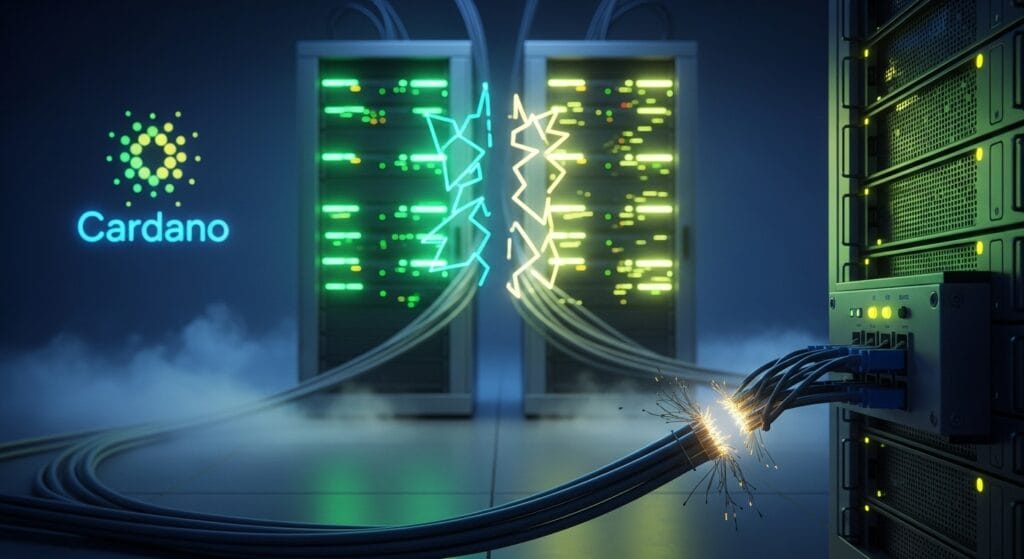
For a few tense hours, Cardano wasn’t one network. It was two. A single, malformed transaction acted like a fork in the road, sending different parts of the network in different directions. It was a clean, unexpected break that revealed a crack in the code.
The problem was a difference of opinion between software versions. Think of it like two bouncers at a club. The older, veteran bouncers (older node software) saw a fake ID (the malformed transaction) and immediately tossed it out. But the newer, less experienced bouncers (updated node software) waved it right in.
Once inside, that bad transaction started causing trouble. Block producers, the people who build and validate the chain, started building on two separate ledgers. One was the original, healthy chain. The other, as the governance body Intersect later called it, was a “poisoned” chain.
The network had forked itself. And the crypto world held its breath.
A Bug, a Bot, and a Confession
Then came the confession. Or, at least, something that looked like one. An X user going by the name “Homer J.” stepped forward to claim responsibility. He said he acted alone. He insisted he wasn’t trying to cause harm, and that he didn’t short or sell any ADA, Cardano’s native token.
His story is a uniquely modern tale of digital mischief. He said he was trying to replicate the bug himself. To do it, he used AI-generated terminal commands to block outside traffic to his machine. It was a contained experiment. Or so he thought.
He only realized something was terribly wrong when the block explorers, the public windows into the blockchain, froze solid. The disruption had escaped his lab and was now running wild across the global network.
“I’m ashamed of my carelessness,” he wrote in a post. “I didn’t have evil intentions, but I endangered the network and caused unnecessary stress.”
Carelessness. That’s one word for it. Developers and network operators probably had a few others as they scrambled to fix the mess. They rushed to deploy a patch, instructing everyone running a node to upgrade their software immediately to get back on the correct, canonical chain.
As a precaution, exchanges and wallet providers slammed the brakes on deposits and withdrawals. While Intersect confirmed no user funds were ever lost, the incident sent a clear signal. The system was more fragile than many assumed.
Two Narratives Collide
Cardano’s co-founder, Charles Hoskinson, saw something more sinister than a clumsy experiment. He characterized the event not as an accident, but as a targeted, premeditated attack. He pointed the finger at a disgruntled stake-pool operator who, he claimed, had been looking for ways “to harm the brand and reputation” of Input Output Global (IOG), one of the core development companies behind Cardano.
So, which is it? A curious tinkerer who got in over his head with an AI assistant? Or a malicious actor bent on sabotage? The truth, as it often does in this space, likely sits somewhere in the gray area between the two stories.
What’s not in dispute is the damage. Hoskinson warned the disruption hit everyone. Block producers lost out on rewards they should have earned. DeFi protocols, which rely on a single, consistent version of the ledger, suddenly had to deal with two. Restoring full network harmony, he said, could take weeks.
This is the quiet cost of a chain split. It’s not just about stolen funds. It’s about lost time, lost income, and a loss of trust. Every hour the network is fragmented is an hour where the core promise of a single, immutable truth is broken.
Retail users were mostly shielded. The report from Intersect noted that most everyday wallets relied on components that correctly ignored the bad transaction. But for the people running the network’s plumbing, it was a very stressful weekend.
The Price of a Stumble
The market, as it always does, delivered its own verdict. In the wake of the news, ADA’s price fell more than 6 percent. It led the losses among major tokens, a clear sign of trader anxiety.
The sell-off wasn’t just about a bug. Bugs happen. They get patched. The deeper concern was about the coordination required to fix a problem in a decentralized network. Getting thousands of independent node operators around the world to upgrade their software on an emergency basis is a monumental task.
It’s a core tension in proof-of-stake systems. They are designed to be run by a distributed community. But when a crisis hits, you suddenly need centralized, decisive action. This incident was a live-fire drill for Cardano’s emergency response, and it exposed some of the logistical hurdles.
The network will recover. The patch is out, and operators are upgrading. But the event leaves behind some important questions. How many other known bugs are lurking in the code? And how prepared are these massive, decentralized machines for the next person who decides to poke them, whether out of malice or simple, AI-assisted curiosity?
The chain is being stitched back together. But the memory of its brief split will linger for a long time.