
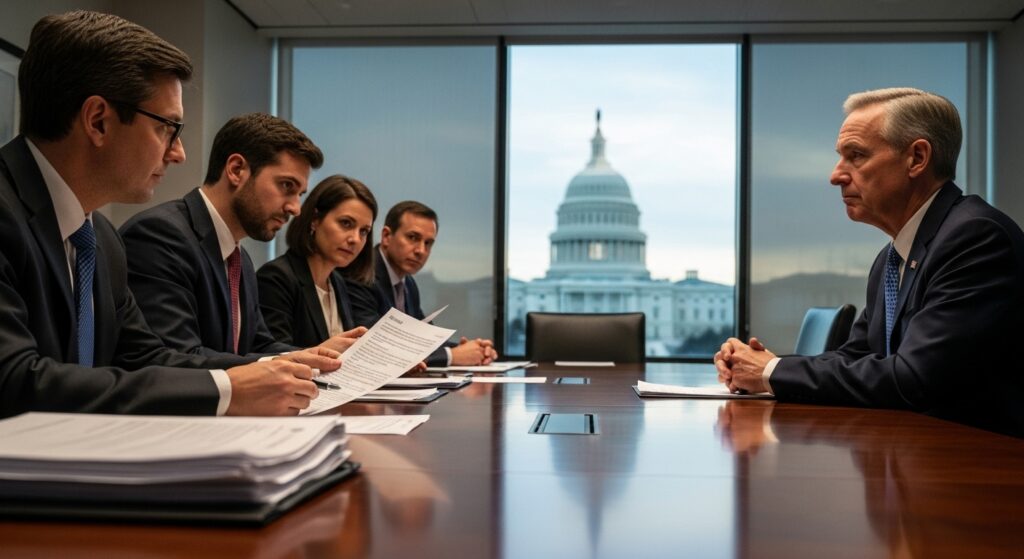
Washington’s legislative gears grind slowly. Sometimes, they don’t seem to grind at all. For the crypto industry, that glacial pace is no longer acceptable. So, they’ve decided to try a different door. A much bigger one.
- Prominent digital asset leaders have bypassed Congress to appeal directly to the White House, seeking immediate regulatory clarity they call “quick wins.”
- The industry is requesting executive action to shield developers from enforcement actions while Congress debates comprehensive market structure legislation.
- Key tax guidance is also sought from the IRS, specifically regarding the taxation of mining/staking rewards and implementing a de minimis exemption for small transactions.


Dozens of the most prominent names in digital assets have sent a letter directly to President Donald Trump. Their message is simple. While Congress debates the grand architecture of market regulation, there are things the White House can do right now. They’re calling them “quick wins.”
This isn’t a fringe group. The letter was spearheaded by the new Solana Policy Institute. It carries the weight of the Blockchain Association, the Digital Chamber, and the Crypto Council for Innovation. Big players like Uniswap, Paradigm, and FalconX also added their signatures. It’s a united front, and they’re tired of waiting.
The backdrop is a familiar story of legislative delay. The Senate is still hashing out its version of a market structure bill, an answer to the House’s Digital Asset Market Clarity Act. Deadlines have come and gone. President Trump and his allies in Congress had hoped for faster progress. But Washington is Washington.
While lawmakers talk, regulators act. The Securities and Exchange Commission (SEC) and the Commodity Futures Trading Commission (CFTC) have been busy carving out their own policies. The industry sees this and feels the urgency. They believe the executive branch can provide clarity and protection without waiting for a new law to be passed.
A Shield for Developers
The first major request is a defensive one. The groups are asking the president to ensure that developers are not targeted by enforcement actions while the rules of the road are still being written. This applies specifically to those building “source-available, permissionless protocols and front-ends.”
Let’s unpack that. A permissionless protocol is like a public park. Anyone can enter and use the swings. The person who designed the park isn’t responsible for what every visitor does there. The industry argues that software developers who write open-source code for DeFi should be seen in the same light.
This isn’t a theoretical concern. The industry is still reeling from the Department of Justice’s prosecution of developers behind Tornado Cash and Samourai Wallet. The founders of Samourai Wallet were sentenced to prison for years. Those cases sent a shockwave through the developer community. Many now fear that simply writing code could land them in legal jeopardy.
The letter asks for an end to any Department of Justice pursuit of DeFi developers on matters of civil liability. They want a clear line drawn. Writing open-source software, they argue, is not the same as operating an unlicensed money transmitting business. It’s a plea for breathing room, a shield to innovate without looking over their shoulder.
Tied to this is a call to protect self-custody. This is the core principle of crypto. It’s your ability to hold your own assets without relying on a bank or a third party. The groups want the SEC and CFTC to affirm this right, ensuring people can always control their own digital wallets.
The Tax Man’s Tangle
Beyond the enforcement worries, the letter tackles a subject that affects every crypto user. Taxes. The industry is asking the Internal Revenue Service for clear, common-sense guidance on a few key issues.
First up are mining and staking rewards. When a miner or staker helps secure a network, they often receive new tokens as a reward. The question is, when should that reward be taxed? The industry argues it shouldn’t be taxed upon creation. Instead, it should be taxed only when the assets are sold or exchanged.
Think of it like an author writing a book. The government doesn’t tax the author for the value of the manuscript the moment it’s finished. It taxes the income when the book is sold. The crypto groups want the same logic applied to newly created digital assets.
Another major request is for a “de minimis” exemption. This would mean that small gains from using crypto to buy everyday things, like a cup of coffee, would be ignored for tax purposes. Right now, every single one of those transactions is technically a taxable event. It’s a logistical nightmare that discourages using crypto for actual commerce.
These tax ideas aren’t new. They echo provisions from bills proposed by lawmakers like Senator Cynthia Lummis, a key Republican voice on crypto policy. The industry is essentially saying, “We know these are good ideas. Congress agrees they’re good ideas. Can you just make them happen?”
A Whole-of-Government Approach
The letter is carefully worded. It’s not just a list of demands. It’s framed as a partnership. It praises President Trump, stating that his administration has “unlocked unprecedented opportunity for crypto investors, users, and builders.”
It directly appeals to his stated goal of “making America the crypto capital of the world.” The letter suggests that these “quick wins” are necessary steps for a “robust whole-of-government approach on crypto” to achieve that objective. It’s a strategic move, aligning their interests with the President’s own agenda.
President Trump has been a vocal supporter of the industry and has personal financial ties to several crypto ventures. The lobbyists are clearly betting that this direct appeal to a friendly White House is their best shot at progress while Capitol Hill remains gridlocked.
It’s a pivot in strategy. For years, the focus has been on educating lawmakers and helping to draft complex legislation. Now, the industry is showing it can play the other side of Pennsylvania Avenue too. They are learning to navigate the executive branch, looking for pressure points and opportunities for immediate action.
This letter is more than a wish list. It’s a sign of a maturing industry that understands how power works in Washington. They’ve identified a bottleneck in Congress and are now trying to build a bypass directly to the agencies that write the rules. Whether that road is open remains to be seen.