
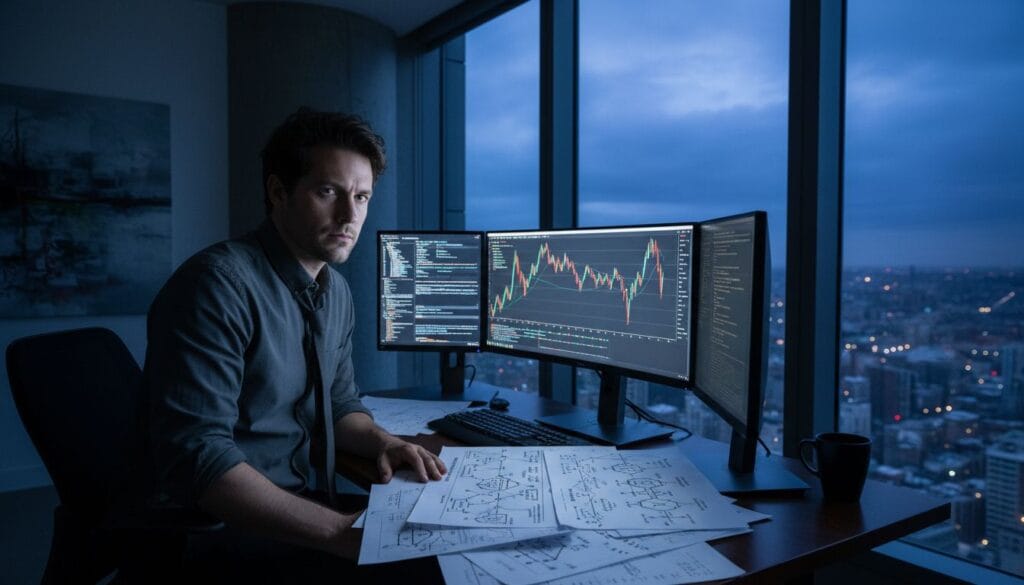
Watching the crypto market on a bad day is a bit like watching a cartoon character run full tilt off a cliff. For a split second, everything seems fine, suspended in mid-air. Then, gravity remembers its job, and the whole thing plummets. It often feels like there are no brakes, no parachutes, and certainly no safety nets. But what if the problem isn’t gravity, but a simple lack of handrails on the staircase?
The Short Version
- Paolo Ardoino is an executive at the crypto exchange Bitfinex.
- Bitfinex is developing a “volatility perpetual” trading tool.
- The firm moved its derivatives business to El Salvador for clarity.
When prices start to fall, the sell-off can turn into an avalanche. Everyone rushes for the exit at the same time, but the exits are small and hard to find. The reason, according to people who build these markets, is that the professional-grade safety equipment that exists in traditional finance is often missing in crypto. It’s a world built for speed, but not always for safety.
Paolo Ardoino, an executive at the crypto exchange Bitfinex, thinks he knows what the missing handrails are. He argues that for crypto to grow up, it needs to offer the same kinds of tools that professional traders use everywhere else, tools for managing risk when the sky is falling.
“If we make sophisticated tools more accessible and connected, institutions can operate with greater efficiency,” he said in a recent interview.
Seatbelts for a Rocket Ship
In the world of finance, one of the most common seatbelts is something called an “option.” Think of it like putting a small, non-refundable deposit on a house. You pay a little bit of money now to get the option to buy the house at today’s price in three months. If the house price skyrockets, you use your option and get a great deal. If the price crashes, you just walk away, losing only your small deposit. It’s a way to protect yourself from wild swings.
In crypto, however, these “options” have often been hard to use. When the market gets turbulent, the protection gets expensive and scarce, like trying to buy flood insurance during a hurricane. This creates a nasty spiral: because protection is hard to get, big traders sell their crypto with blunt force, which pushes the price down further, which makes the insurance even harder to buy.
Bitfinex is trying to solve this by building a better toolkit. One of their new tools is a “volatility perpetual.” This sounds complicated, but the idea is simple. Instead of betting on whether Bitcoin’s price will go up or down, you’re betting on how bumpy the ride will be. It’s a tool for traders who want to protect themselves from general chaos, not just a price drop.
During periods of market turbulence, the primary needs from our sophisticated clients always revolve around execution reliability and robust risk management tools.
Ardoino says this is exactly what serious traders ask for. They don’t just want a “buy” and “sell” button. They want a whole dashboard of dials and levers to navigate the storm.
The Biggest Headache: Juggling Money in a Dozen Pockets
Here’s another problem that makes bad situations worse. Imagine you’re at a giant shopping mall. You have cash in your pocket for the food court, a gift card for the bookstore, and a store credit for the electronics shop. If you find a great deal on a TV but don’t have enough on your electronics store credit, you can’t just use your food court cash. You have to go through the hassle of cashing everything out and moving it around. It’s slow and clumsy, and you might miss the sale.
This is how many crypto trading platforms work. Money for one type of trade sits in one bucket, and money for another type sits in a completely different bucket. During a market panic, traders waste precious time moving funds around just to cover their positions. It’s inefficient and adds to the chaos.
Bitfinex’s solution is something called a “universal account.” It’s like having a single debit card that works in every single store in the mall. All your funds, no matter their type, are in one place. The system is smart enough to see your entire financial picture at once. This frees up a lot of money that was just sitting on the sidelines, waiting to be moved. It makes the whole system more efficient.
If they can use a universal account with a risk-based margining system like portfolio margin, they are no longer forced to silo excessive collateral for every individual position.
Ardoino believes this simple change can make the entire market more stable. When the big players can manage their risk more easily, they are less likely to panic. “This approach helps improve market maturity,” he said. “It allows institutional players to hedge more effectively, which in turn leads to a more stable and orderly market overall.”
Building on Solid Ground
To build these kinds of serious, long-term tools, you need a predictable environment. This is why Bitfinex moved its derivatives business to El Salvador. It’s not about finding a place with no rules, but rather a place with clear rules. It’s like trying to build a house. You need to know the zoning laws and building codes won’t suddenly change halfway through construction.
Ardoino says this regulatory clarity is key to building the boring, useful infrastructure that crypto needs to mature. It gives companies the confidence to invest for the long haul.
They’ve also partnered with, and are now merging with, a company called Thalex, which specializes in crypto options. The goal is to make trading these complex products seamless. Instead of signing up for a whole new service with separate logins and wallets, Bitfinex customers can access everything from one place. It’s like Amazon adding a “Buy Insurance” button right next to the “Buy Now” button. If it’s easy, people will use it.
So, What Does This Mean for the Rest of Us?
You might be thinking, “This is all very interesting for giant trading firms, but I just buy a little crypto now and then. Why should I care?”
It’s a fair question. The answer is that when the biggest players in the market have better safety gear, the whole ride gets smoother for everyone. When a hedge fund can easily buy insurance against a crash, they don’t need to panic-sell all their Bitcoin at the first sign of trouble. When a market maker, the financial equivalent of a grocer who is always ready to buy or sell apples, can manage their risk better, they don’t disappear when things get scary. This prevents the market from seizing up.
All this boring “plumbing” leads to a market that is less prone to those terrifying, cliff-dive moments. The sudden, gut-wrenching price drops become less common. The downward spirals that are fueled by forced sellers run out of steam faster. The market begins to behave more like a mature asset class and less like a casino.
This won’t stop prices from going down sometimes. But it can make the journey down a steep hill instead of a vertical drop. For crypto to become a lasting part of our financial world, it needs these handrails, these seatbelts, and this boring, reliable plumbing. It’s the unglamorous work that ultimately makes the entire system safer for everyone involved.