




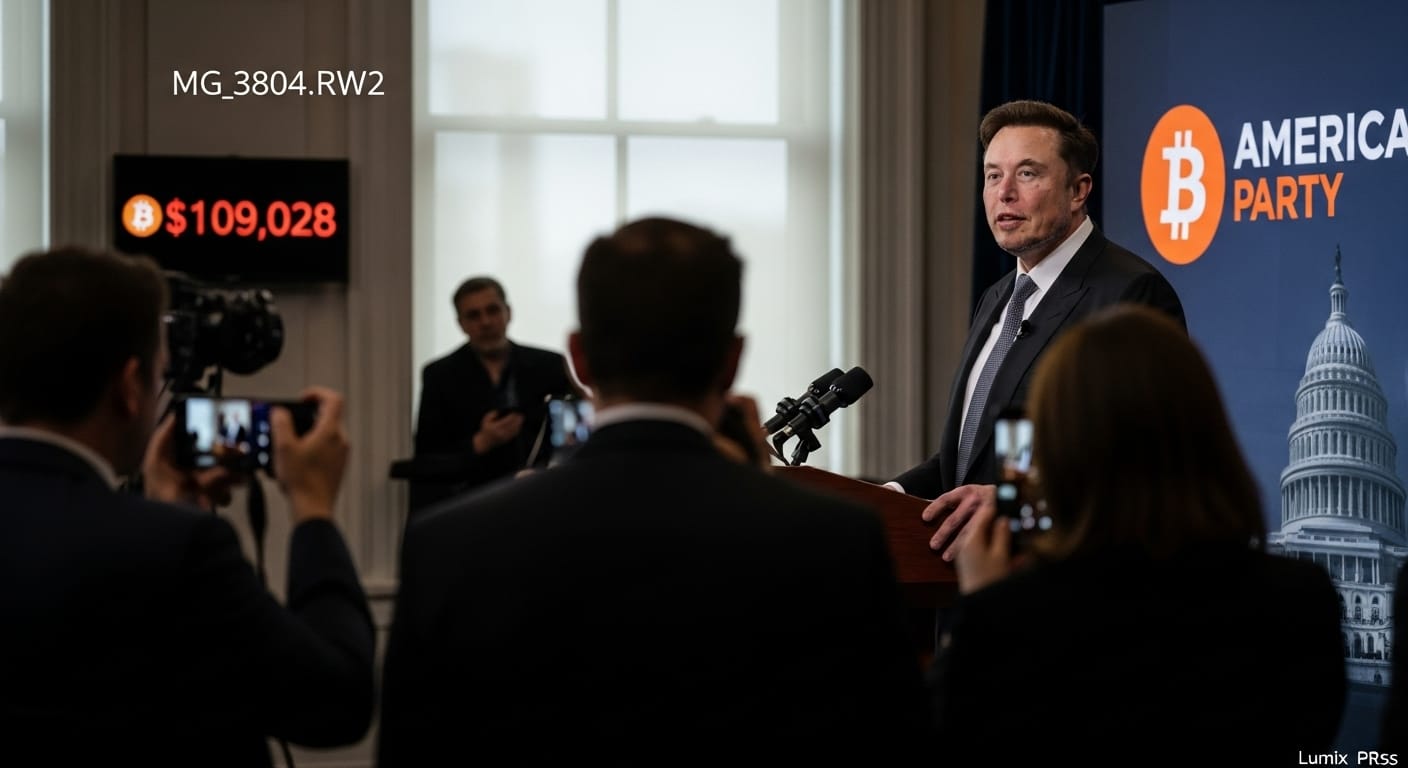
Imagine sitting down for coffee, and someone tells you a new political party just formed. Then, they add that this party plans to throw its weight behind Bitcoin. That is exactly what Elon Musk, the Tesla CEO, announced over the weekend. He calls his new venture the “America Party.”
- Elon Musk announced the formation of the “America Party” and its support for Bitcoin, signaling a potential shift in the intersection of technology, finance, and government.
- Musk’s strong stance against fiat currency and his support for Bitcoin reflect a distrust in traditional monetary systems, resonating with those who view Bitcoin as a hedge against inflation.
- The America Party aims to challenge the established two-party system in the United States, with a focus on key races and a tactical approach to influence policy.

The news broke on X, the social media platform Musk owns. A user asked if his new party would support Bitcoin. His reply was direct. “Fiat is hopeless, so yes,” Musk stated. This short sentence carries a lot of weight for anyone watching the intersection of technology, finance, and government.
For those new to the term, “fiat” money is what we use every day. It is currency declared legal tender by a government. Think of the dollars in your wallet. Its value comes from trust in the issuing government, not from a physical commodity like gold.
Musk’s declaration that fiat is “hopeless” is a strong statement. It suggests a deep distrust in traditional monetary systems. This sentiment often resonates with those who see Bitcoin as a hedge against inflation and government overspending. Bitcoin, after all, has a fixed supply. No central authority can print more of it.


The formation of the America Party came after Musk polled the idea on X. He launched the party on Saturday. Its stated goal is to challenge the established two-party system in the United States. This is a bold ambition, given the historical hurdles third parties face.
Musk did not mince words about his motivation. He wrote on X, “When it comes to bankrupting our country with waste & graft, we live in a one-party system, not a democracy.” He continued, “Today, the America Party is formed to give you back your freedom.” Strong words, indeed.
This political move follows a public disagreement between Musk and President Trump. The dispute centered on a massive spending package. It was a $3.4 trillion bill, dubbed the “Big, Beautiful Bill.” President Trump signed it into law just last week.
Musk was a vocal critic of this bill. He called it a “disgusting abomination.” His concern was the significant increase it would bring to the U.S. deficit. This is a topic many people care about, regardless of their political leanings.
It is worth remembering Musk’s past actions. He once led something called the Department of Government Efficiency, or DOGE. Its purpose was to cut federal spending. So, his criticism of a large spending bill aligns with his stated principles.
Musk outlined a strategy for his new party. He suggested focusing on a few key races. “One way to execute on this would be to laser-focus on just 2 or 3 Senate seats and 8 to 10 House districts,” he posted on X. He believes this focused approach could make a difference.
He added that “Given the razor-thin legislative margins, that would be enough to serve as the deciding vote on contentious laws, ensuring that they serve the true will of the people.” It is a tactical approach, aiming for leverage rather than a sweeping takeover.
The Political Chessboard and Bitcoin’s Place
President Trump, for his part, quickly responded to Musk’s announcement. He posted on Truth Social, saying Musk had gone “completely off the rails.” President Trump also pointed out a historical fact. A third political party has never truly succeeded in the history of the U.S.
This historical perspective is certainly true. Third parties often struggle to gain traction against the entrenched Republican and Democratic machines. They face challenges with funding, media coverage, and voter recognition.
Despite these challenges, the America Party has already launched an official website. This shows a certain level of commitment and speed. It is not just an idea floating on social media.
Some notable figures have already shown interest. Billionaire Mark Cuban is one. Anthony Scaramucci, founder of SkyBridge Capital, is another. Their interest adds a layer of credibility, at least in the financial and business worlds.
However, the party is still in its very early stages. It has not been formally registered with the Federal Election Commission. Musk also has not yet provided a detailed roadmap. These are practical steps that lie ahead for any serious political organization.
So, what does this mean for Bitcoin? If a political party, even a nascent one, officially backs Bitcoin, it could bring the digital currency into mainstream political discourse. It moves Bitcoin beyond just a financial asset or a tech curiosity.
It places Bitcoin squarely in conversations about national debt, monetary policy, and economic freedom. This is a significant shift. It could force more politicians to learn about digital assets, whether they like it or not.
The idea of a political party supporting Bitcoin is not entirely new. We have seen individual politicians express support. But an official party platform, even one in its infancy, is a different animal. It suggests a more organized push for Bitcoin adoption at a policy level.
Consider the implications for regulation. If Bitcoin becomes a political talking point, it could influence how laws are shaped. Will we see more favorable regulations? Or will it invite more scrutiny from those who remain skeptical?
This move also highlights the ongoing debate about the nature of money itself. Is fiat truly “hopeless”? Many economists would disagree. But the argument for decentralized, permissionless money like Bitcoin gains a louder voice when someone like Musk champions it.
Bitcoin’s Current Standing and Future Outlook
Amidst all this political chatter, Bitcoin continues to trade. The price of Bitcoin was up 0.78% in the past 24 hours. It stood at $109,028. This information comes from The Block’s Bitcoin price page.
Bitcoin’s price movements are often influenced by a mix of factors. These include market sentiment, institutional adoption, regulatory news, and macroeconomic trends. Now, it seems, political endorsements might also play a part.
A high-profile figure like Musk publicly linking Bitcoin to a political platform could certainly draw more attention. It might even encourage more people to consider Bitcoin as a viable alternative to traditional money.
The question remains: How much impact can a new party, even one backed by a billionaire, truly have? History suggests it is an uphill battle. But history also shows that public opinion can shift, sometimes rapidly.
Will the America Party gain enough traction to influence policy? Will its pro-Bitcoin stance resonate with voters beyond the crypto community? These are questions that will unfold in the coming months and years.
For now, Bitcoin continues its journey. It moves along its own path, sometimes volatile, sometimes steady. Yet, it is increasingly finding itself woven into the fabric of broader societal conversations, including those about how nations manage their money.
It is a fascinating time to watch. The lines between technology, finance, and politics are blurring more each day. And Bitcoin, it seems, is right there at the center of it all.