




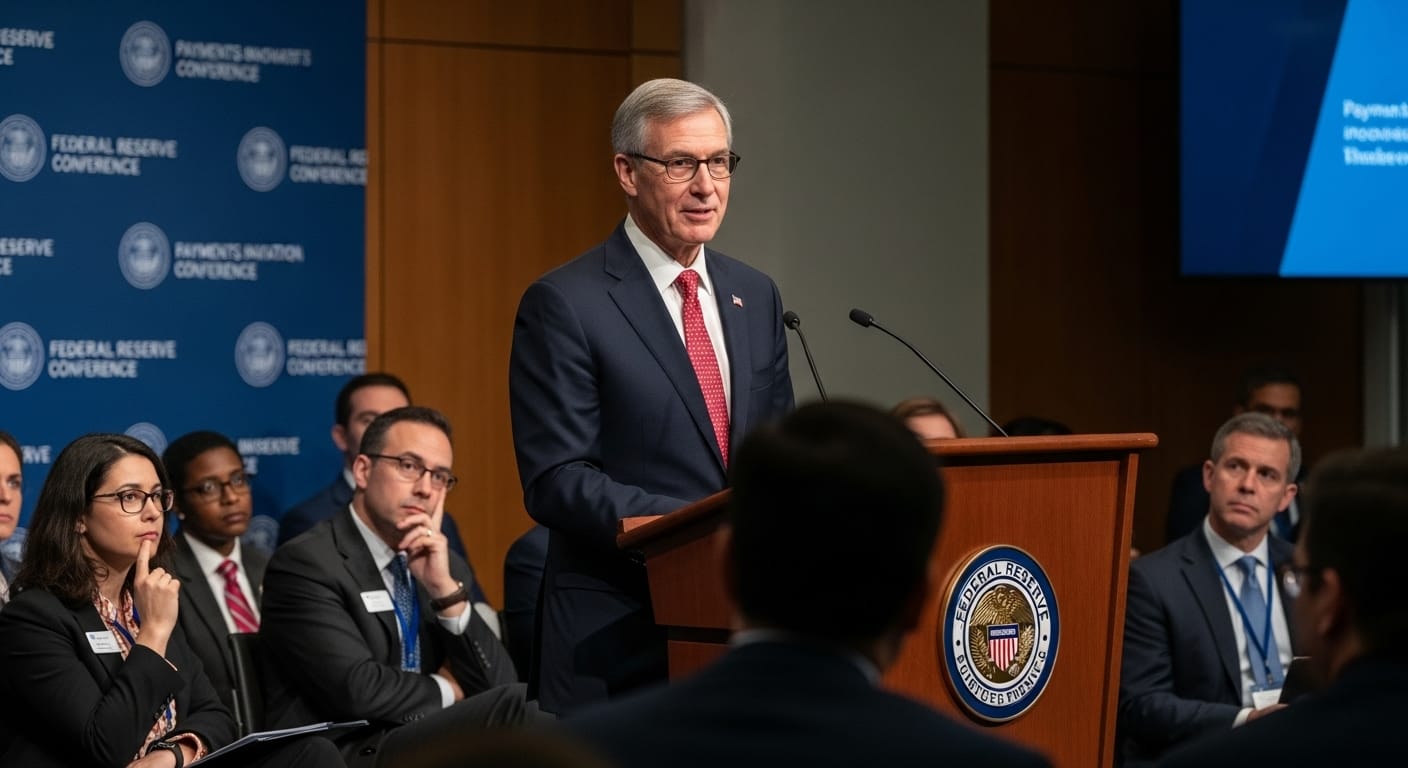
For years, the crypto world often felt like a guest at a formal dinner, politely tolerated but never quite at home. Regulators eyed it with a mix of suspicion and bewilderment. Then, Federal Reserve Governor Christopher Waller stepped up to the podium this week, and the air in the room shifted. He spoke of a new era, a welcome mat laid out for innovators.
- Federal Reserve Governor Christopher Waller has signaled a significant shift in the Fed’s stance towards cryptocurrency, moving from suspicion to welcoming innovation. He stated that cryptocurrency will “no longer be on the fringes” and that the DeFi industry is welcomed to the conversation on the future of payments.
- The Fed has been quietly altering its stance over the past year, withdrawing guidance that discouraged banks from crypto involvement and removing “reputational risk” from their bank examination program. These actions indicate a pragmatic approach, recognizing the growing integration of digital assets into financial systems.
- Governor Waller proposed a “skinny master account” concept, a basic Federal Reserve payment service for entities focused on payment innovation. This aims to simplify operations and reduce reliance on traditional banking partners, offering a more direct pathway for innovation while managing risks.
It was a moment that made some of us in the crypto space blink. Waller, a member of the Fed’s Board of Governors, nominated by President Trump in 2020, declared that cryptocurrency would “no longer be on the fringes.” He said this at the Fed’s Payments Innovation Conference, a setting that gave his words real weight.
Imagine the scene. A room full of financial minds, and a top Fed official says the decentralized finance (DeFi) industry is “not viewed with suspicion or scorn.” He went on to say, “Rather, today, you are welcomed to the conversation on the future of payments in the United States and on our home field.” That’s quite a change from the cold shoulder many felt just a few years back.
Waller’s comments signal a significant turn. He noted that distributed ledgers and crypto are increasingly “woven into the fabric of the payment and financial systems.” This isn’t just talk; it reflects a tangible shift in how the central bank sees digital assets.


A Policy Wind Change
This isn’t the first sign of a thaw. Over the past year, the Federal Reserve has quietly but firmly altered its stance. They withdrew guidance that once discouraged banks from getting involved with crypto and stablecoin activities. Think of it as removing a “Do Not Enter” sign that had been up for a while.
They also removed “reputational risk” from their bank examination program. For a long time, banks worried about the mere association with crypto. This change was a quiet victory for the industry, helping to push back against the practice of “debanking,” where financial institutions cut ties with crypto firms due to perceived risks.
These actions, taken together, paint a clear picture. The Fed is moving from a position of caution, bordering on apprehension, to one of engagement. It’s a pragmatic approach, recognizing that digital assets aren’t going away. They are, in fact, growing more integrated into the broader financial landscape.
Some might wonder what sparked this policy shift. Perhaps it’s the sheer persistence of the crypto industry. Or maybe it’s the growing recognition that ignoring innovation won’t make it disappear. Either way, the message from the Fed is now one of openness.
It’s a bit like watching a long-standing rivalry soften. The Fed, once a stern gatekeeper, now seems ready to invite the new kids on the block to play. This doesn’t mean a free-for-all, of course. Regulation will always be a part of the game. But the tone has certainly changed.
Introducing the “Skinny Master Account”
Beyond the welcoming words, Governor Waller also put forward a concrete idea: a “payment account.” He asked the Fed to look into this concept, specifically for entities focused on payment innovation. He even gave it a catchy nickname: the “skinny master account.”
What exactly is a master account? Think of it as a direct line to the Federal Reserve. It allows financial institutions to access the Fed’s payment systems directly. This provides the most direct access to the U.S. money supply available. Without one, institutions often rely on partner banks that do have master accounts, adding layers of complexity and cost.
The “skinny master account” would offer basic Federal Reserve payment services. It targets legally eligible institutions that currently operate through a third-party bank. This could be a game-changer for many crypto-native firms or other payment innovators.
Waller explained that this account would provide access to the Federal Reserve payment rails. These are the underlying systems that move money around the country. It would do this while still controlling for various risks to the Fed and the payment system itself.
There would be some limitations, though. The “skinny” part means it wouldn’t be a full-fledged master account. For instance, the Reserve Banks would not pay interest on balances held in these payment accounts. Also, balance caps might be put in place.
These limitations are designed to control the size of the accounts. They also manage any associated impacts on the Fed’s balance sheet. It’s a cautious step, a way to offer access without fully opening the floodgates. It’s a sensible approach to integrating new players while managing systemic stability.
For many in the crypto space, this proposal could simplify operations. It could reduce reliance on traditional banking partners. It offers a more direct, and potentially more efficient, pathway for innovation in payments.
The Path Ahead for Digital Payments
The Fed’s Payments Innovation Conference itself speaks volumes. It included panels on tokenization and stablecoins. These are topics that were once niche, discussed only by a dedicated few. Now, they are front and center at a major central bank event.
Tokenization, for example, involves representing real-world assets on a blockchain. Stablecoins are cryptocurrencies designed to maintain a stable value, often pegged to a fiat currency like the U.S. dollar. Both are areas with significant implications for the future of finance.
The discussions at the conference, coupled with Waller’s statements, suggest a future where digital assets are not just tolerated. They are actively considered as components of the payment system. This doesn’t mean the wild west days of crypto are over. Far from it. But it does mean a more structured, perhaps more predictable, environment is taking shape.
What does this mean for you, the curious reader? It means the lines between traditional finance and the digital asset world are blurring. It means more avenues for innovation could open up. It means the conversation around crypto is maturing, moving from speculation to practical application.
The journey from the fringes to the “home field” is a long one. But Governor Waller’s words, and the Fed’s recent actions, mark a clear turning point. It’s a signal that the future of payments will likely have a significant digital asset component, and the central bank is ready to talk about it.