




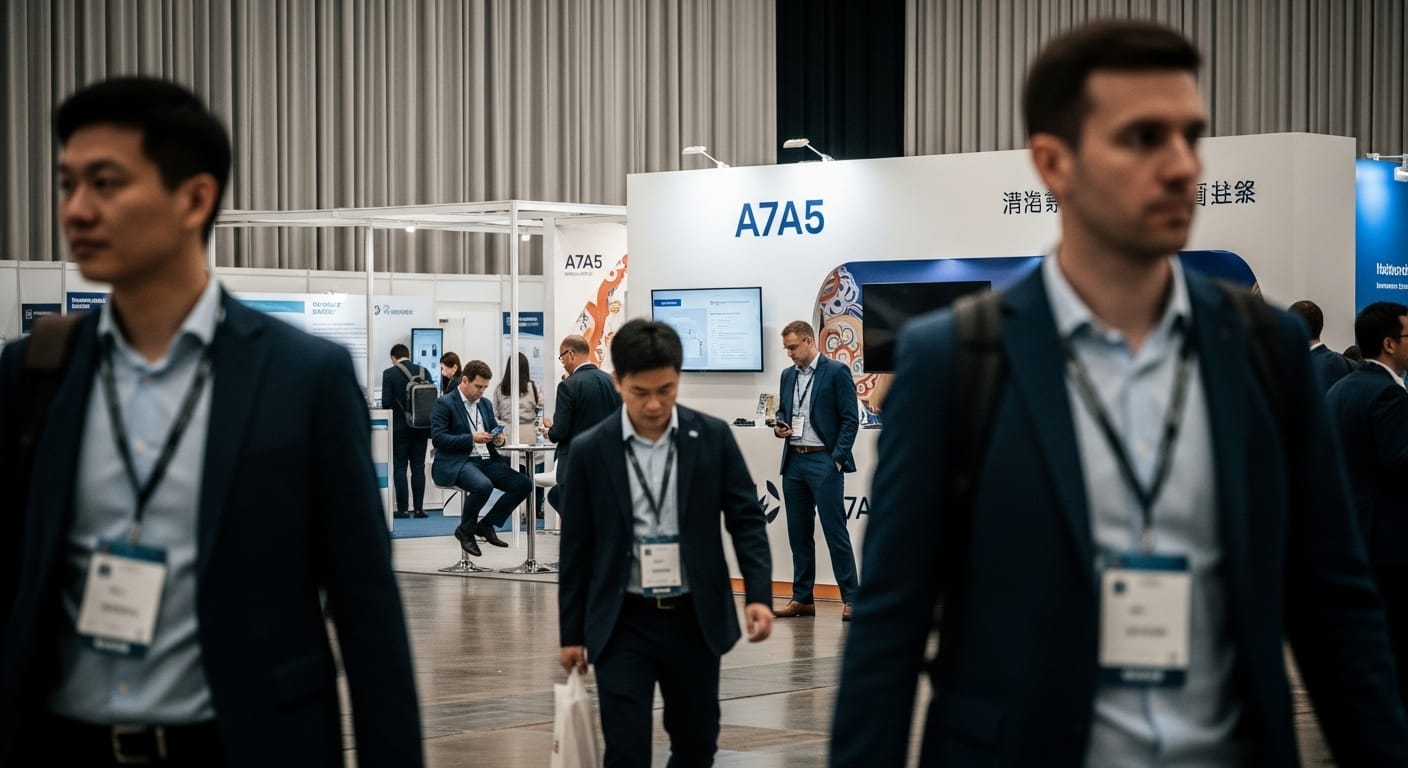
The buzz at Token2049 in Singapore was electric, as always. But tucked among the usual suspects, a certain stablecoin issuer raised a few eyebrows. A7A5, a name perhaps not on everyone’s radar, made a splash. They sponsored the event, set up booths, and even offered branded massage rooms. Quite the spread, wouldn’t you say?
- A7A5, a stablecoin issuer linked to Russia’s Promsvyazbank (PSB), which is sanctioned by multiple Western jurisdictions, participated openly in Token2049 in Singapore.
- Singapore’s Monetary Authority (MAS) clarified that its sanctions framework targets financial institutions, not non-financial companies like the event organizer, allowing A7A5’s participation.
- This situation highlights the divergent approaches to sanctions enforcement globally, with the U.S. having a broader definition of prohibited interactions compared to Singapore’s focus on financial intermediaries.

Here’s the rub: A7A5’s ruble-based stablecoin is backed by Russia’s state-owned Promsvyazbank (PSB). And PSB, well, it’s a name that rings alarm bells in many financial capitals. The Monetary Authority of Singapore (MAS) has sanctioned PSB. So have the U.S., the U.K., and most Western jurisdictions. The European Union is even weighing sanctions against A7A5 itself.
This situation makes you wonder. How could a company linked to a sanctioned bank openly participate in a major crypto conference in Singapore? Did it not go against the rules? I certainly scratched my head a bit.
The answer, according to MAS, is straightforward. “Singapore financial institutions (FI) are not permitted to facilitate transactions (whether directly or indirectly) for designated persons in contravention of our financial measures,” a MAS Spokesperson told CoinDesk. They added, “An entity that is not an FI regulated by the MAS is not subject to the financial measures.”


This means Singapore’s sanctions framework has a specific target. It binds banks, insurers, capital-markets intermediaries, and digital payment token providers. But it doesn’t extend to everyone. Non-financial companies and individuals in Singapore only need to comply with United Nations-mandated sanctions. And Russia, being a member of the U.N. Security Council, would simply veto any such measures against itself.
So, the organizer of Token2049, Hong Kong-registered BOB Group, isn’t a financial institution under MAS’s purview. Hong Kong, as part of China, also has no financial sanctions on Russia. This made receiving funds from A7A5 perfectly legal in that territory. It paints a picture of a global crypto landscape where rules can vary greatly from one city-state to the next.
A Tale of Two Sanction Regimes
The Singapore approach stands in stark contrast to what we see in the U.S. There, the company behind A7A5 is a Specially Designated National (SDN) under the U.S. Treasury’s Office of Foreign Assets Control (OFAC). This designation means U.S. persons are prohibited from interacting with them in any way. It’s a much broader net.
To illustrate just how far U.S. restrictions can go, consider the case of *Foundation for Global Political Exchange v. U.S. Treasury*. OFAC initially denied a U.S. nonprofit permission to host members of Hezbollah (sanctioned individuals, understandably) at a forum. Simply offering a platform or audience was deemed a prohibited service.
Only after a legal challenge did OFAC reverse its position. They allowed participation under very strict conditions: no payments, no lodging, no coordination, and no affiliation with the event’s host. It shows the U.S. takes a wide view of what “interaction” means when it comes to sanctioned entities.
By that U.S. standard, even hosting A7A5 could be legal if no money or material support changed hands. But in Singapore, the line is drawn differently. Sanctions bind financial institutions, not conference organizers. Washington regulates who you can pay. Singapore regulates who can move the money. It’s a subtle but important distinction.
Somewhere between these two philosophies, and with a Hong Kong crypto wallet in the mix, A7A5 found its perfectly legal booth. And yes, those branded massage rooms. Who doesn’t appreciate a good neck rub after a long day of conference panels?
💆 Your Neck’s New Best Friend at TOKEN2049
Back-to-back panels? Hours of networking? We’ve got you.
Step into the A7A5 Massage Zone – 110 sqm of pure relaxation on Level 5.💆 10-minute hand, arm, & neck massages by professional therapists.
⏰ Open throughout event hours
🌿… pic.twitter.com/P77BMohO3o— A7A5 (@A7A5official) September 25, 2025
This whole episode highlights the complex, sometimes contradictory, nature of global sanctions in the digital age. Crypto operates across borders, but regulations often stop at them. It leaves projects and participants navigating a patchwork of rules, trying to stay on the right side of the law in every jurisdiction.
For those building in crypto, this isn’t just an academic exercise. It’s a practical challenge. Understanding where these lines are drawn, and how they differ, becomes crucial. It shows how a project can be fully compliant in one region, yet completely off-limits in another. A fascinating dance, isn’t it?
Market Snapshot
Beyond the regulatory debates, the broader markets saw some movement. Bitcoin, for instance, fell to around $122,000. That’s down 3% from its recent record highs. Analysts suggested the crypto rally might have become a bit overheated. We saw large ETF inflows and leveraged positioning. Deribit projected a possible pullback to $118,000–$120,000 before another run toward $130,000. It’s a reminder that even in a bull market, corrections happen.
Ethereum also saw a dip. It traded around $4,479, down 4.4%. Traders seemed to be locking in profits after recent gains. Some rotated out of ETH into other assets. This put pressure on prices following what had been a strong rally.
Gold, the traditional safe haven, surged past $4,000 for the first time. Investors flocked to it amid a weaker dollar, Fed rate cuts, and geopolitical uncertainty. Central banks and retail buyers drove demand. Goldman Sachs even lifted its 2026 forecast to $4,900. Bank of America, however, warned the rally might be overextended. It’s always good to hear both sides, isn’t it?
Asia-Pacific markets traded mixed. Japan’s Nikkei 225 hovered around 48,120. Optimism over pro-growth policies under new LDP leadership buoyed it. A tech-fueled global rally also helped. Still, concerns about stimulus durability and valuation risks lingered. The global economy, much like crypto regulations, rarely offers a simple, clear path.