




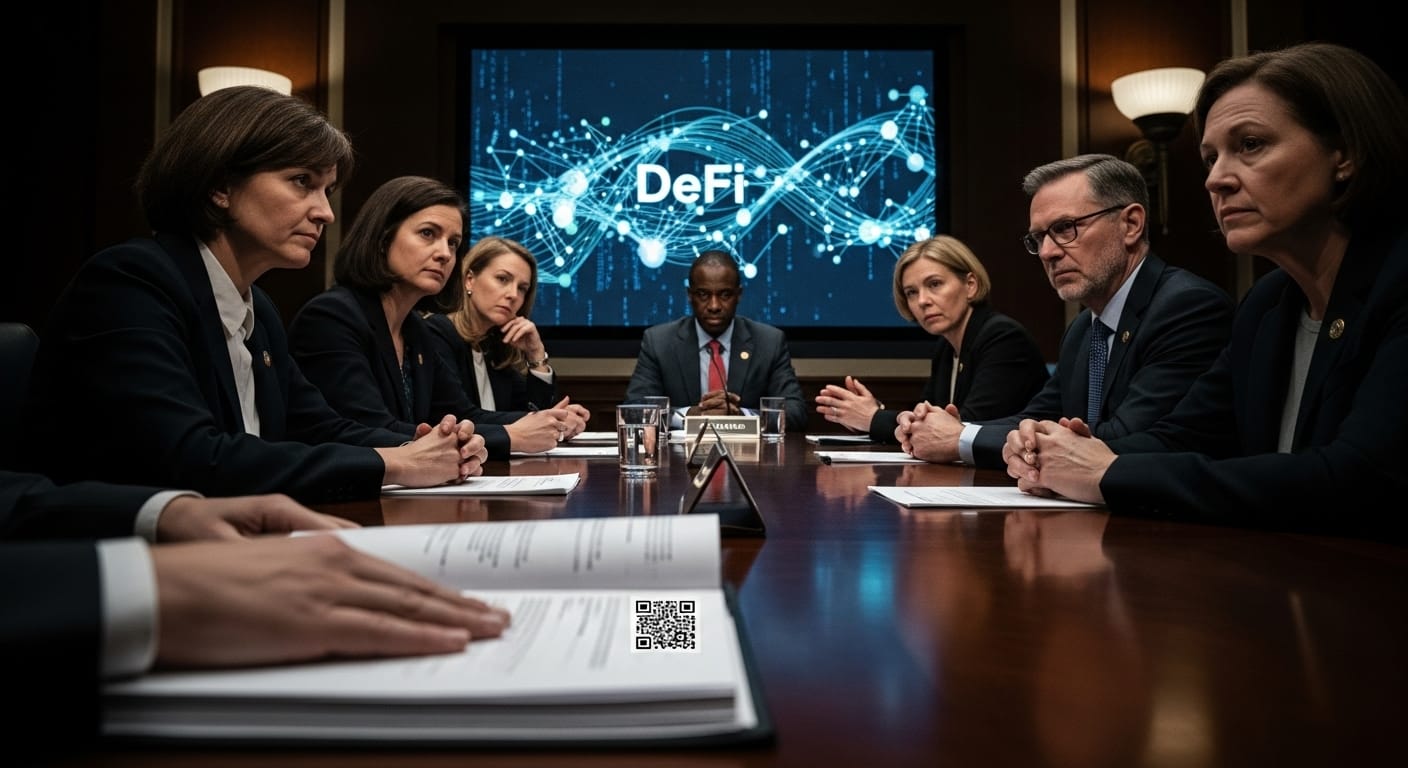
A fresh legislative proposal from Senate Democrats has landed in the crypto world, and it’s stirring up quite a dust storm. The aim, we’re told, is to keep illicit activities out of decentralized finance (DeFi). But many in the industry, and even some Republicans, see it as a wrecking ball instead of a guardrail.
- A new legislative proposal from Senate Democrats aims to regulate decentralized finance (DeFi) by targeting illicit activities. However, the industry and some Republicans view it as potentially harmful to innovation.
- The proposal grants significant power to the Treasury Department to define control and decentralization within DeFi protocols, raising concerns about compliance and the definition of “intermediary.”
- Industry leaders and legal experts have voiced strong opposition, warning that the proposal could effectively ban DeFi and drive development overseas due to its broad and potentially unworkable language.
This isn’t just another policy paper. It’s a six-page document, shared with Republicans on the Senate Banking Committee, that outlines a vision for regulating DeFi. The details, however, have sparked immediate and sharp criticism.
Summer Mersinger, CEO of the Blockchain Association, didn’t mince words. She warned that the proposal, as written, would “effectively ban decentralized finance, wallet development and other applications.” That’s a strong statement, suggesting a serious disconnect between intent and impact.
“The language as written is impossible to comply with and would drive responsible development overseas,” Mersinger added. It paints a picture of innovation being forced to pack its bags, seeking friendlier shores.


So, what exactly is in this proposal that has everyone so worried? For starters, it hands a significant amount of power to the Treasury Department and other financial regulators. They would get to define when a person or entity “exercises control or sufficient influence” over a DeFi protocol.
Think about that for a moment. The Treasury would also decide if a “protocol is sufficiently decentralized.” This is a bit like asking a government agency to define what makes a community truly self-governing. It’s a complex question, often debated even within crypto circles.
The proposal also casts a wide net for who counts as an “intermediary.” This term would apply to anyone who “designs, deploys, controls, operates a front-end service for a DeFi protocol.” It also includes those who “materially benefit from a decentralized finance protocol that facilitates covered financial activities.”
That last part is particularly broad. What does “materially benefit” truly mean in the context of open-source software or community-driven projects? It could sweep up a lot of people who simply contribute to the ecosystem, not just those running a centralized business.
The Battle for Regulatory Clarity
This proposal isn’t happening in a vacuum. The Senate has been working on its own legislation to regulate the broader crypto market structure. This effort follows the House, which passed its version earlier this summer.
The Senate Banking Committee’s draft has been looking to clarify jurisdiction between the Securities and Exchange Commission (SEC) and the Commodity Futures Trading Commission (CFTC). It also aims to create a new term, “ancillary assets,” to help distinguish which cryptocurrencies are not securities.
Republicans on the committee expressed their willingness to work with Democrats on market structure. However, a spokesperson for the Republicans noted that this specific proposal wasn’t a “legislative offer.” They called it “not written in legislative text” and containing “multiple incoherent policy ideas.”
It seems the Republicans felt this wasn’t a “good-faith effort to engage on market structure.” This kind of political back-and-forth is a familiar sight in Washington, especially when new technologies are involved. It often feels like two ships passing in the night, each with its own compass.
Democrats on the committee had previously laid out a framework. That framework aimed to “close regulatory gaps” and bring crypto issuers into a “regulatory framework.” The goal was to ensure proper oversight, but the devil, as always, lives in the details.
To pass a market structure bill, Republicans need some Democratic support in the Senate. And whatever the Senate eventually passes, it will need to be reconciled with the House’s version. It’s a long road, paved with negotiations and compromises.
Meanwhile, the Senate Agriculture Committee, which oversees the CFTC, has yet to release its own version of the bill. This adds another layer of complexity to an already intricate legislative puzzle. It’s a bit like trying to assemble a jigsaw puzzle where half the pieces are still missing.
Industry Voices Speak Out
The reaction from the crypto community was swift and largely negative. Jake Chervinsky, chief legal officer at the Variant Fund, took to X to voice his concerns. He called the Democrats’ proposal “unserious.”
These Senators claim to be pro-crypto, but what they propose is basically a crypto ban. It’s hard to imagine a good deal happening right now.
— Jake Chervinsky (@jchervinsky) February 29, 2024
Chervinsky’s words echo the sentiment that this proposal, despite its stated goals, could stifle innovation rather than simply regulate it. It highlights the tension between preventing bad actors and allowing legitimate development to flourish.
The core of the issue seems to be how regulators define and categorize decentralized systems. If a protocol is deemed “controlled” by someone, or not “sufficiently decentralized,” it could face heavy regulatory burdens. This could make many current DeFi applications unworkable.
It raises a fundamental question: can traditional regulatory frameworks, built for centralized entities, truly apply to decentralized networks without fundamentally altering their nature? It’s a challenge that lawmakers around the globe are grappling with.
This latest proposal from Senate Democrats certainly adds a new twist to the ongoing saga of crypto regulation in the United States. It underscores the deep divisions and differing philosophies at play. Finding a path forward that satisfies both innovation and oversight will be no small feat.