




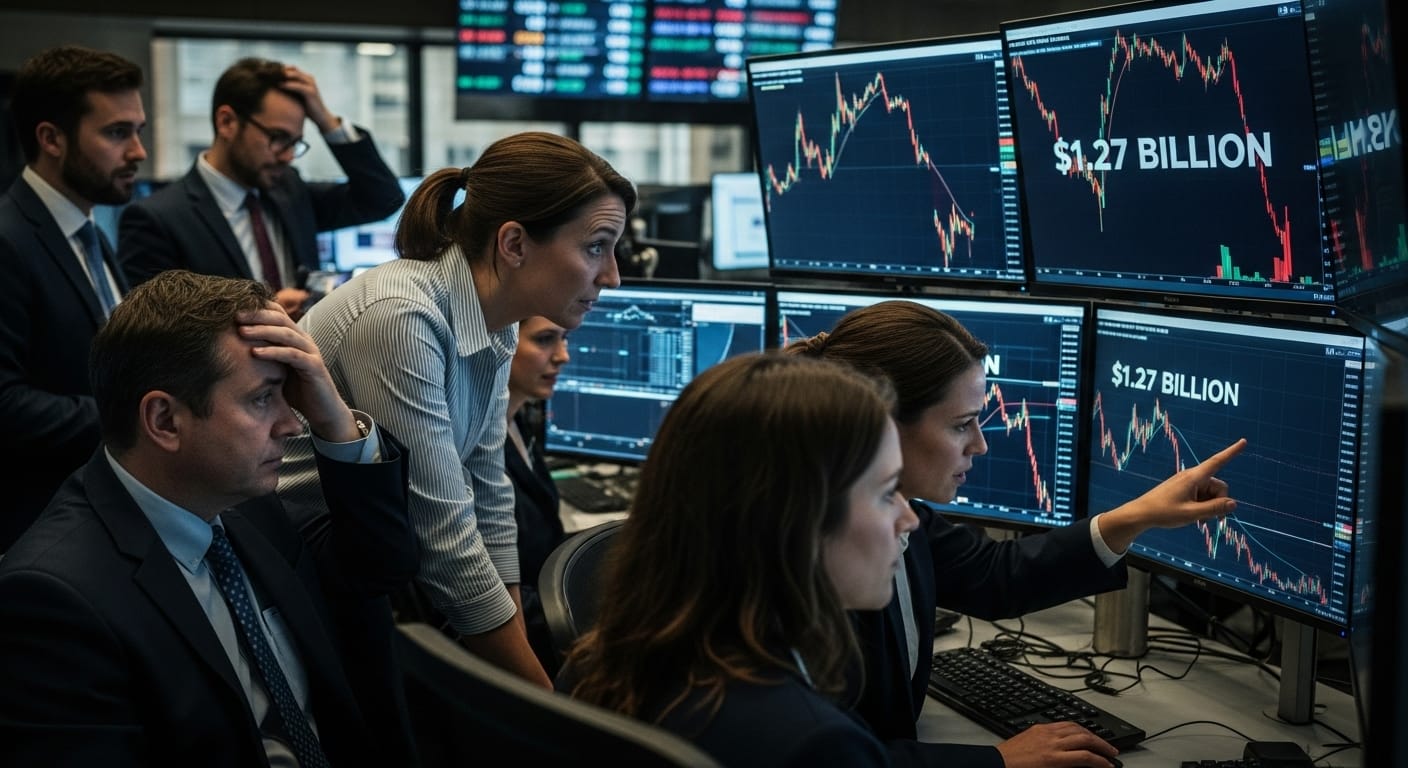
The crypto market often moves with a sudden, sharp intake of breath, then exhales in a rush. This past Monday, that breath turned into a gasp, as Bitcoin’s price took a swift dive. It fell from $112,000 to below $106,000 in a blink. This drop triggered a wave of forced selling, washing over the market with surprising force.
- Bitcoin experienced a sharp price drop on Monday, leading to over $1.27 billion in leveraged futures liquidations, primarily affecting long traders.
- These liquidations are a result of traders using borrowed money (leverage) and their positions being automatically closed when the market moves against them, often exacerbating price drops.
- The market is currently cautious due to upcoming Federal Reserve decisions and thin order books, which amplify price swings and the impact of liquidations.


More than $1.27 billion in leveraged futures positions simply vanished. Think of it like a row of dominoes, each one representing a trader’s bet. When the first one fell, the rest followed quickly. This wasn’t just a small tremor; it was one of the largest liquidation events we’ve seen in weeks.
Data from CoinGlass, a firm that tracks these movements, painted a clear picture. Long traders, those betting prices would rise, bore the brunt of it. Nearly 90% of the total liquidations, a staggering $1.14 billion, came from their bullish positions. Short sellers, who bet on falling prices, saw only $128 million wiped out. It seems the bulls were caught off guard.
What exactly is a liquidation? It’s when traders use borrowed money, or leverage, to place bigger bets. If the market moves sharply against their position, their initial deposit, called margin, can fall too low. The exchange then automatically closes their position to prevent further losses. It sells their assets into the open market, often making the price drop even faster.


These forced sales can be quite dramatic. They create a feedback loop, pushing prices down further, which triggers more liquidations. It’s a bit like a crowded theater where everyone tries to exit at once. The rush creates more chaos.
For those watching the charts, large clusters of long liquidations can be a sign. They sometimes point to a moment of capitulation, where bullish sentiment finally breaks. This can often precede a short-term bottom, a point where prices might stabilize before a rebound. Conversely, heavy short liquidations can signal a local top, where momentum shifts.
Traders often track where these liquidation levels are concentrated. These zones of forced activity can act as temporary support or resistance levels. They are like invisible tripwires on the price chart, waiting to be sprung.
One particular trade stood out in this recent flurry. On the HTX exchange, a single Bitcoin-USDT long position, valued at $33.95 million, was closed out. That’s a significant sum for one position to lose.
Looking at the platforms where this activity hit hardest, Hyperliquid led the pack. It registered $374 million in forced closures. A remarkable 98% of these were long positions. Bybit followed with $315 million, and Binance saw $250 million in liquidations. These numbers show just how widespread the impact was.
The market flush came right after Bitcoin tried and failed to hold above $113,000. It was a clear rejection. Adding to the drama, order books across major perpetual futures exchanges were thin. This means there weren’t many buyers or sellers waiting at various price points. Thin order books amplify price swings, making cascading liquidations even more impactful, especially during low-liquidity hours.
These kinds of events are often called “clearing moments.” They happen in overheated markets, where too many traders are using too much borrowed money. The liquidations effectively reset the leverage in the system. After the dust settles, spot buyers, those buying with their own funds, tend to step back in slowly.
Still, the air remains thick with caution. Open interest, which measures the total number of outstanding futures contracts, hovers near $30 billion. Funding rates, which are periodic payments between long and short traders, have eased only slightly. This suggests traders aren’t completely out of the woods. They remain wary of further volatility.
Why the continued caution? The Federal Reserve’s rate decision is due later this week. Such announcements often send ripples through all financial markets, crypto included. Traders are holding their breath, waiting to see what the Fed will do.
Bitcoin wasn’t the only asset feeling the squeeze. Ethereum and Solana also faced similar pressure. Their combined liquidations topped $300 million. Most altcoins, the smaller digital assets, tracked lower as well. It seems the appetite for speculative bets faded across the board, at least for a moment.
This recent market shake-up reminds us of a fundamental truth in crypto: what goes up can come down, and often does so with surprising speed. It’s a market that demands attention, a place where fortunes can turn on a dime. The question now is, what will the next turn bring?