




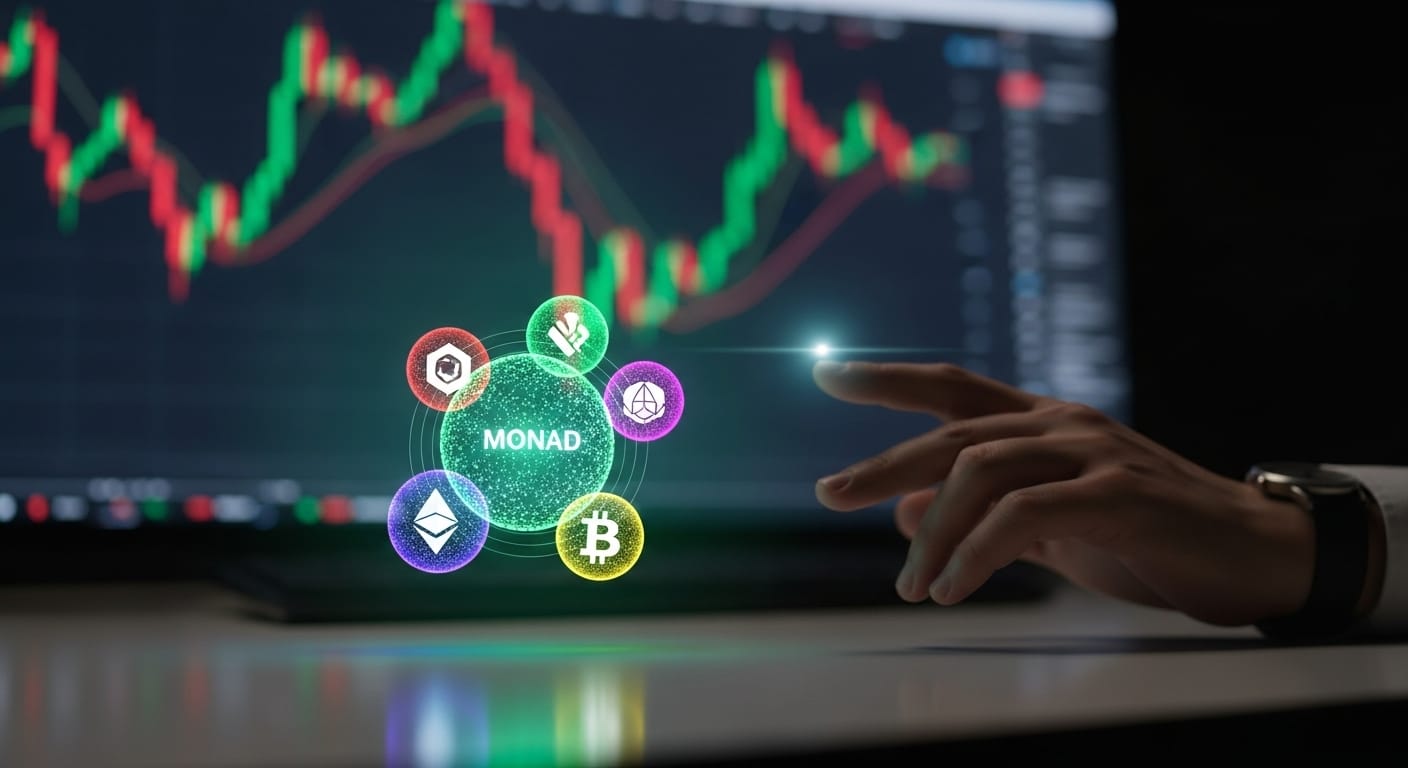
The first few minutes after a token goes live are always a bit of a street fight. For Monad’s new MON token, the fight was brief but messy. After a week-long public sale on Coinbase, buyers received their allocations and some immediately headed for the exits. The price dipped below its $0.025 sale price, touching $0.02. For a moment, it looked like a fizzle.
- The launch of Monad’s MON token on Coinbase’s new platform saw initial volatility, with the price briefly dipping below the $0.025 sale price before recovering strongly. Nearly 86,000 participants from over 70 countries observed the debut of this new token-sale mechanism.
- Coinbase aims for its new platform to host orderly sales attracting long-term believers, contrasting with past chaotic initial coin offerings. The sale was oversubscribed by 1.43 times, indicating high market demand for the offering.
- An early confusion regarding Coinbase’s “flipping” policy was clarified, confirming that withdrawing tokens to participate in Monad’s ecosystem is not penalized. This highlights the tightrope exchanges walk between encouraging trading volume and rewarding patient, long-term holders.
But the floor held. The token didn’t just recover. It climbed. By mid-afternoon Monday, MON was trading around $0.0365, a tidy 46% gain for those who held their nerve. This wasn’t just another token launch. It was the debut of Coinbase’s new token-sale platform, and nearly 86,000 people from over 70 countries were watching their wallets to see how the experiment would turn out.
The demand was never really in question. The sale aimed to raise $187.5 million. It attracted $269 million in commitments. That’s a 1.43 times oversubscription. In simple terms, for every three tokens available, more than four people wanted to buy them. It’s a sign of a hungry market, one that Coinbase is hoping to feed in a more orderly fashion than the chaotic initial coin offerings of years past.
An Exchange’s Wager
Coinbase is playing a long game here. The exchange wants to be the grown-up in the room for token launches. It wants to host sales that attract long-term believers, not just short-term speculators. Internal polling from the company suggested most Monad buyers fit that profile. They were in it for the technology, for the future, for the long haul.


Still, old habits die hard in crypto. A bit of confusion arose before the tokens were even distributed. Language in a Coinbase explainer document warned that quickly “flipping” tokens could result in smaller allocations in future sales. This caused a stir. What exactly counts as flipping? If a user withdraws their new MON tokens to a private wallet to use them in Monad’s applications, is that a punishable offense?
It’s a fair question. The whole point of a utility token is, well, to be utilized. Penalizing people for using the product they just bought would be a strange business model. A few participants worried that the system might misinterpret their on-chain activity as speculation.
We’ve seen some questions about our token sale flipping policy. Withdrawing tokens onchain to participate in the ecosystem is not in itself penalized under this mechanism. We want to ensure that users who want to participate in the ecosystem are able to do so.
— Coinbase Support (@CoinbaseSupport) May 20, 2024
A Coinbase spokesperson thankfully cleared the air. They told The Block that moving MON to participate in the network “is not in itself penalized.” It was a necessary clarification. The line between an investor and a user is meant to be blurry in crypto. Discouraging one to get the other doesn’t work.
This entire episode highlights the tightrope exchanges walk. They need the trading volume that speculators bring. But they also need the stability that long-term holders provide. Coinbase is trying to nudge behavior with its new platform, rewarding patience over impulse. The Monad sale was its first real-world test.
A Tale of Two Valuations
With the initial volatility settled, the market started doing its math. With a price of $0.0365 and a circulating supply of roughly 38.5 billion tokens, Monad’s market capitalization sat around $394 million. That’s the value of all the tokens currently available for trading. It’s a respectable figure for a project on its first day.
But that’s not the number that gets people talking. The big one is the fully diluted valuation, or FDV. This metric calculates a project’s value if all possible tokens were in circulation. For Monad, that number is a hefty $3.6 billion. How do you get from a $394 million market cap to a $3.6 billion FDV? The answer lies in locked tokens.
A huge chunk of the total MON supply, about 50.6%, is currently locked away. These tokens belong to the team, early investors, and the foundation treasury. They can’t be sold. They can’t be traded. They are sitting in digital vaults with timers on them. Vesting for these allocations doesn’t even begin until the second half of 2026, and it will continue slowly through 2029.
This creates a fascinating dynamic. The FDV is a statement of ambition. It’s a bet that by the time all those tokens are available, the Monad network will have grown enough to justify that massive valuation. The current market cap is a statement of reality. It’s what traders are willing to pay today for the portion of the project they can actually own.
The $450 million in 24-hour trading volume shows there are plenty of people willing to make that bet. The launch wasn’t just a token sale. It was timed perfectly with the Monad mainnet going live. This isn’t just a theoretical asset. It’s the native currency of a functioning blockchain, supported from day one by giants like MetaMask, Phantom, Curve, and Uniswap. You can hold MON, but you can also use it, right now.
That immediate utility is what separates a serious project from a simple cash grab. The road from a $394 million reality to a $3.6 billion ambition is long. It will be paved with code, community growth, and probably a few more days of wild price swings. For the 86,000 people who got in on the ground floor, the real journey has just begun.