




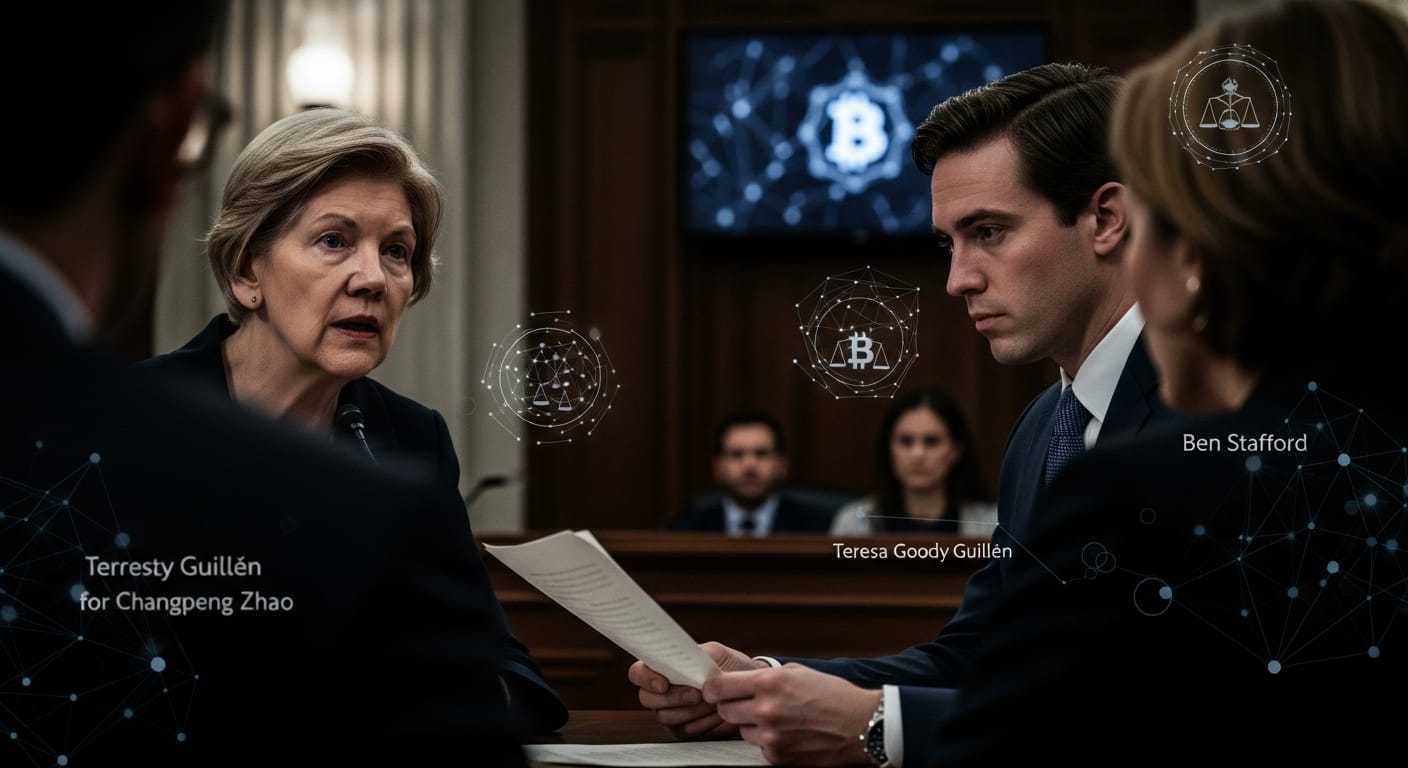
A quiet legal storm is brewing, one that pits a powerful U.S. Senator against a titan of the crypto world. At its heart lies a disagreement over a few carefully chosen words, words spoken in the wake of a presidential pardon. It’s a classic Washington tale, but with a digital currency twist.
- Senator Elizabeth Warren stated that Binance founder CZ pleaded guilty to a criminal money laundering charge, a claim CZ’s legal team disputes.
- CZ’s lawyer argues he pleaded guilty to a regulatory count for failing to implement an anti-money laundering program, not a criminal money laundering charge.
- Senator Warren’s lawyer maintains her statement was accurate, as CZ pleaded guilty to a criminal violation of the Bank Secrecy Act, a key anti-money laundering statute, which resulted in a prison sentence.

Senator Elizabeth Warren, a well-known voice on financial regulation, found herself in the crosshairs of Changpeng “CZ” Zhao, the founder of Binance. The dispute started shortly after President Trump issued a pardon for CZ. Senator Warren, never one to shy from strong statements, took to X, asserting that CZ “pleaded guilty to a criminal money laundering charge.”
Now, CZ’s legal team isn’t taking that assertion lightly. His lawyer, Teresa Goody Guillén, quickly demanded a retraction. She even threatened a defamation lawsuit if Senator Warren didn’t back down. It seems the crypto world, already a place of high stakes, just added a courtroom drama to its list of spectacles.
Goody Guillén argued that CZ “pleaded guilty to a single regulatory count—failure to implement an effective anti-money laundering program under the Bank Secrecy Act.” She drew a clear line, suggesting this was not the same as a “criminal money laundering charge.” CZ himself echoed this sentiment on X, stating, “There were NO money laundering changes [sic].”


But Senator Warren’s lawyer, Ben Stafford, has pushed back. He sent a letter, obtained by Punchbowl News, firmly rebuffing the defamation allegations. Stafford’s stance is clear: Senator Warren’s statement was “true in all respects.” He contends she “accurately represented publicly available and widely reported facts.”
The Heart of the Matter: A Question of Language
This isn’t just a squabble over semantics. It cuts to the core of how legal charges are understood, especially in the public eye. Stafford’s letter explains that Mr. Zhao “pled guilty to a criminal charge, presented through an information by the Department of Justice, and resulting in a prison sentence.” He points out that CZ “did plead guilty to a criminal violation of the Bank Secrecy Act.”
For those of us not fluent in legal speak, the Bank Secrecy Act is a big deal. Stafford’s letter describes it as “our nation’s first and most comprehensive anti-money laundering statute.” It’s the law that requires financial institutions to help the government fight money laundering. So, a violation of this act, in Stafford’s view, is indeed a criminal matter related to money laundering prevention.
Think of it this way: if you’re charged with failing to install proper safety equipment in a factory, and that failure leads to an accident, the charge isn’t just about the missing equipment. It’s about the dangerous outcome it enabled. Similarly, failing to implement an effective anti-money laundering program isn’t just a paperwork issue. It’s a failure in preventing illicit funds from moving through the system.
Stafford also made a point about “regulatory penalties.” He noted that such penalties “do not exist” in this context. This suggests that the plea wasn’t just a slap on the wrist, a fine for a minor infraction. It was a criminal conviction, carrying the weight of a prison sentence.
The distinction matters immensely for CZ’s reputation. Being associated with a “criminal money laundering charge” carries a different public perception than a “regulatory count.” It’s a difference that could impact future business dealings and public trust.
Legal Chess and Public Figures
Goody Guillén, in her initial letter, stated that CZ “will not remain silent while a United States Senator seemingly misuses the office to repeatedly publish defamatory statements that impugn his reputation and cause him further injury.” Strong words, indeed. It shows the seriousness with which CZ’s team views Senator Warren’s comments.
However, Stafford’s response also touched on the high bar for defamation lawsuits, especially when a public figure is involved. He explained that even if absolute immunity didn’t apply, Mr. Zhao would need to prove specific elements. A public figure like CZ cannot succeed in a defamation claim without showing that the defendant published a false statement of fact with “actual malice.”
What does “actual malice” mean in this legal dance? It means the person making the statement either knew it was false or acted with reckless disregard for the truth. It’s a tough standard to meet, designed to protect free speech, particularly when discussing public figures and matters of public interest.
Stafford’s letter reiterated that Senator Warren’s statement was “completely accurate.” He added, “In any event, the standard is speech-protective.” This suggests that even if there was some ambiguity, the law leans towards protecting the speaker, especially a politician commenting on a public figure’s legal issues.
The Senator’s lawyer also clarified the scope of her X post. “Her X Post does not state—and should not be construed to state—that he pled guilty to any other money laundering charge,” Stafford’s letter states. This aims to narrow the interpretation of Warren’s words, focusing only on the specific charge CZ faced.
This entire episode highlights the delicate balance between public discourse, legal accuracy, and personal reputation. In the fast-paced world of social media, where statements can spread globally in seconds, the precise wording of a legal charge becomes a battleground. For crypto figures, often under intense scrutiny, every word from a prominent politician carries weight.
The legal back-and-forth continues, a reminder that even after a pardon, the echoes of past legal battles can linger. It leaves us wondering how this specific legal challenge might shape future interactions between lawmakers and the crypto industry.